
You are using an out of date browser. It may not display this or other websites correctly.
You should upgrade or use an alternative browser.
You should upgrade or use an alternative browser.
turbocad's custom fx
- Thread starter turbocad6
- Start date
- Location
- Portland, OR
theres no aftermarket plenums yet for that motor
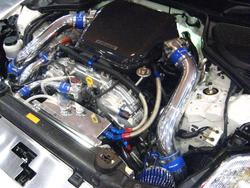
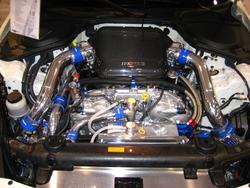
This one's from '07. Guess it never made it to production...
- Location
- brooklyn, ny
that has to be a cover, all the bolts go through the middle of this intake really, so there'd be no way to install that intake if it was all one piece. the bolts must be undernieth that.a cover like that wouldn't be too hard to make, that can be vacuum formed really  I'll worry about the cosmetics after, gotta get through the grimey stuff first & get this whole big pile of parts all working first .
tonight I dragged soon & ayia to home depot to pick up a 14" chop saw, then we made stillen header sparks fly all over the place as we chopped up my stillen headers. I flipped the flanges & shortened them a little at the flange to tuck them in closer to the block, adjusted the angle a bit & now they do fit. the equal length mandrel bent header is so much nicer than the hr crush bend unequal length manifolds I think, even though the hr manifolds did actually fit better & were much more compact. these are def going to take more work & I'm going to have to also relocate the power steering pump to the oposite side of the engine down low under the a/c compressor I think .
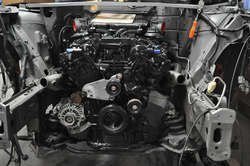
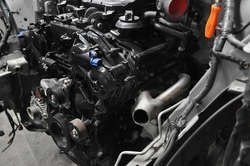
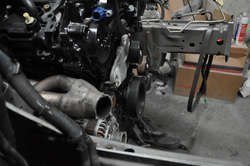
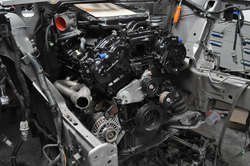
I'll worry about the cosmetics after, gotta get through the grimey stuff first & get this whole big pile of parts all working first .tonight I dragged soon & ayia to home depot to pick up a 14" chop saw, then we made stillen header sparks fly all over the place as we chopped up my stillen headers. I flipped the flanges & shortened them a little at the flange to tuck them in closer to the block, adjusted the angle a bit & now they do fit
. the equal length mandrel bent header is so much nicer than the hr crush bend unequal length manifolds I think, even though the hr manifolds did actually fit better & were much more compact. these are def going to take more work & I'm going to have to also relocate the power steering pump to the oposite side of the engine down low under the a/c compressor I think .- Location
- brooklyn, ny
I found 2" bends with a 4" radius bend instead of the 8" that I was trying tonight, so I'll be able to move the turbos back enough to fit I think. the hr manifolds def allowed better turbo positioning but the bends I can get now should make it ok I think
- Location
- Portland, OR
Very nice!
I can't imagine that equal length headers won't be beneficial in a turbo application... Just doesn't make sense. Logically, it would have to more efficiently spin the turbos. I would imagine this to be a much more important benefit when only three cylinders are spooling each turbo.
Either way your fabrication is impressive and I admire your can-do attitude!
I can't imagine that equal length headers won't be beneficial in a turbo application... Just doesn't make sense. Logically, it would have to more efficiently spin the turbos. I would imagine this to be a much more important benefit when only three cylinders are spooling each turbo.
Either way your fabrication is impressive and I admire your can-do attitude!
- Location
- brooklyn, ny
what I'm gathering is that equal length headers are to eliminate some back pressure in NA aplications by avoiding the collision of pulses, but a turbocharger itself is backpressure anyway, & can be more back pressure by itself than the difference equal length or not can even make, so the benifits are not nearly as much as NA, however there still can be some benifits even if not as much in the higher rpms, so that's good enough for me to at least try for them.
to me the mandrel bends, better piping, slightly larger tubing & much better collector all add up to enough reason to do this with the stillen headers over the HR manifolds with crush bends & more restrictive collectors anyway, even aside from the equal length factor they'll just flow much better....
today I solved my problem of turbo positioning with these, gonna wind up with some funky looking headers but they should work really well. now because of these bends I'm going to even wind up being able to keep equal length from each collector to each turbo too, another thing that doesn't really matter all that much I guess, but it mattering even just a little then it's better to be the same than not....
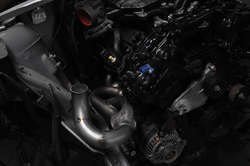
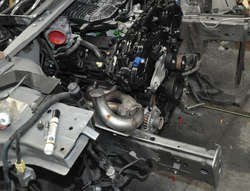
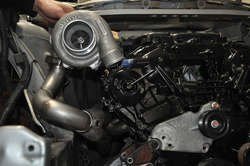
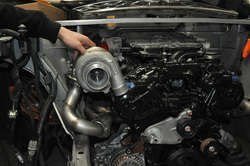
to me the mandrel bends, better piping, slightly larger tubing & much better collector all add up to enough reason to do this with the stillen headers over the HR manifolds with crush bends & more restrictive collectors anyway, even aside from the equal length factor they'll just flow much better....
today I solved my problem of turbo positioning with these, gonna wind up with some funky looking headers but they should work really well. now because of these bends I'm going to even wind up being able to keep equal length from each collector to each turbo too, another thing that doesn't really matter all that much I guess, but it mattering even just a little then it's better to be the same than not....
- Location
- Portland, OR
what I'm gathering is that equal length headers are to eliminate some back pressure in NA applications by avoiding the collision of pulses, but a turbocharger itself is back pressure anyway, & can be more back pressure by itself than the difference equal length or not can even make, so the benefits are not nearly as much as NA, however there still can be some benefits even if not as much in the higher rpms, so that's good enough for me to at least try for them.
...
If you think of a giant horizontal wheel (like a "merry-go-round") being spun by three people at various locations around the perimeter. Each of the three people can only push once per rotation, and each pushes for a circumferential distance equivalent to 5 degrees of rotation.
In circumstance A (unequal length headers), the three people are standing right next to each other. In this case the wheel has 345 degrees of rotation to slow down before it is powered again.
In circumstance B (equal length headers), the instance of separation is equal for the three people. ie, one person every 120 degrees. In this case the wheel only has 115 degrees of rotation to slow down between pushes.
Though the collective input force is the same in both examples above, the more time the wheel is given to slow down the harder it is for the people to speed it up again. Thus, the wheel in option B would "spool" to it's max speed faster, and be capable of carrying more weight than option A.
- Location
- brooklyn, ny
if this were a tri-scroll turbo I'd agree somewhat, but the way I see it, think of headers like lanes of traffic. equal length will make the lanes alternate 1-2-3-1-2-3-1-2-3 etc., & because there equal length this merging without collision happens at every frequency throughout the band.
unequal length will of course cause collisions at some frequencies, although unequal can be still tuned for a specific frequency & at & around that frequency the lanes can still merge 1-2-3-1-2-3 etc, but above or below the tuned freq. then the collisions will occur. for example the HR factory manifolds are of course not equal length, but they are tuned to optimum efficency in the upper rpm range or at peak tourque, or where ever the engineers at nissan designed them to be tuned too, so while they will not perform as well as an equal length header at some points they can act like equal length in a certain range too....
the whole idea of equal length is to keep traffic moving as smoothly as possible. the collectors also are designed for this, as well as the rest of the exhaust really.... all this is designed to keep the exhaust pulses moving like thousands of cars on a very very high speed highway with minimal collisions & bottlenecks... this is normally asperated
adding a turbo is like adding a toll booth to the high speed highway, bam, traffic jam at the toll booth & will back up all traffic before the toll booth, that's back pressure. traffic will be bumper to bumper all the way up until it can pass the tollbooth & then resume it's trip on the high speed highway. this back pressure is what makes the equal length less effective, because there will inevitably be much more collisions whether the merges are equal length or not really once a turbo is in the picture... the pulses can't step on the brakes, so the only thing that stops them is colliding into the pulses before it that are facing back pressure of the toll booth. they must all push thru the toolbooth, with this backpressure there are always pulses waiting to take there turn to push through & the pressure is applied throughout the whole 360* of rotation. this is not to say there aren't benefits from equal length, I'm sure there are benefits even though there is back pressure, but the back pressure makes it not as significant as it would be had it been NA
this is another reason why you can tune a NA car with the exhaust system really & sometimes no exhaust or too big of an exhaust is not as good as a smaller exhaust might be on a NA car, but the same does not apply with a turbo. with a turbo the only good exhaust is no exhaust after the turbo. of course that's not always practical, but the bigger the better when it comes to turbo exhaust, this again is because of that back pressure caused by the turbo, the engine cannot benefit from any additional backpressure from the exhaust because it's already restricted too much by the turbo to begin with...
unequal length will of course cause collisions at some frequencies, although unequal can be still tuned for a specific frequency & at & around that frequency the lanes can still merge 1-2-3-1-2-3 etc, but above or below the tuned freq. then the collisions will occur. for example the HR factory manifolds are of course not equal length, but they are tuned to optimum efficency in the upper rpm range or at peak tourque, or where ever the engineers at nissan designed them to be tuned too, so while they will not perform as well as an equal length header at some points they can act like equal length in a certain range too....
the whole idea of equal length is to keep traffic moving as smoothly as possible. the collectors also are designed for this, as well as the rest of the exhaust really.... all this is designed to keep the exhaust pulses moving like thousands of cars on a very very high speed highway with minimal collisions & bottlenecks... this is normally asperated
adding a turbo is like adding a toll booth to the high speed highway, bam, traffic jam at the toll booth & will back up all traffic before the toll booth, that's back pressure. traffic will be bumper to bumper all the way up until it can pass the tollbooth & then resume it's trip on the high speed highway. this back pressure is what makes the equal length less effective, because there will inevitably be much more collisions whether the merges are equal length or not really once a turbo is in the picture... the pulses can't step on the brakes, so the only thing that stops them is colliding into the pulses before it that are facing back pressure of the toll booth. they must all push thru the toolbooth, with this backpressure there are always pulses waiting to take there turn to push through & the pressure is applied throughout the whole 360* of rotation. this is not to say there aren't benefits from equal length, I'm sure there are benefits even though there is back pressure, but the back pressure makes it not as significant as it would be had it been NA
this is another reason why you can tune a NA car with the exhaust system really & sometimes no exhaust or too big of an exhaust is not as good as a smaller exhaust might be on a NA car, but the same does not apply with a turbo. with a turbo the only good exhaust is no exhaust after the turbo. of course that's not always practical, but the bigger the better when it comes to turbo exhaust, this again is because of that back pressure caused by the turbo, the engine cannot benefit from any additional backpressure from the exhaust because it's already restricted too much by the turbo to begin with...
- Location
- Portland, OR
if this were a tri-scroll turbo I'd agree somewhat, but the way I see it, think of headers like lanes of traffic. equal length will make the lanes alternate 1-2-3-1-2-3-1-2-3 etc., & because there equal length this merging without collision happens at every frequency throughout the band.
...
I know, my example is even more true if you consider the possibility of collisions.
...
unequal length will of course cause collisions at some frequencies, although unequal can be still tuned for a specific frequency & at & around that frequency the lanes can still merge 1-2-3-1-2-3 etc, but above or below the tuned freq. then the collisions will occur. for example the HR factory manifolds are of course not equal length, but they are tuned to optimum efficency in the upper rpm range or at peak tourque, or where ever the engineers at nissan designed them to be tuned too, so while they will not perform as well as an equal length header at some points they can act like equal length in a certain range too....
...
Correct me if I'm wrong but we're talking about pressure pulses traveling around 18" of pipe @ the speed of sound right? Is there ever a time in which the lanes don't merge in consecutive order? I thought the issue is the difference between 1--2-3---1--2-3 and 1-2-3-1-2-3. ie, a difference in cadence rather than order.
Also, the HR manifold much like the DE plenum is a product of space constraints and cost, among other things, which is certainly why the tubes aren't equal length. Engineers rarely have the chance to design primarily for performance.
...
adding a turbo is like adding a toll booth to the high speed highway, bam, traffic jam at the toll booth & will back up all traffic before the toll booth, that's back pressure. traffic will be bumper to bumper all the way up until it can pass the tollbooth & then resume it's trip on the high speed highway. this back pressure is what makes the equal length less effective, because there will inevitably be much more collisions whether the merges are equal length or not really once a turbo is in the picture... the pulses can't step on the brakes, so the only thing that stops them is colliding into the pulses before it that are facing back pressure of the toll booth. they must all push thru the toolbooth, with this backpressure there are always pulses waiting to take there turn to push through & the pressure is applied throughout the whole 360* of rotation. this is not to say there aren't benefits from equal length, I'm sure there are benefits even though there is back pressure, but the back pressure makes it not as significant as it would be had it been NA
...
True, but regardless of the ambient pressure in the manifold, every time the exhaust valve opens you have another pressure wave that travels down the header tube at the speed of sound toward the turbo. When it reaches the turbo (granted it can be slowed down by back pressure) it acts on the impeller like a dude spinning a merry-go-round. This seems to me like a benefit only seen in turbo applications.
Check this out: EXPLANATION

- Location
- Westchester, New York
- Car
- 09 FX50
I want
- Location
- brooklyn, ny
OK, I see what your saying now, & yeah, I guess you are right. either way we both know that equal length tubular headers are going to be the best way to go for turbo headers of course no matter what & will def be better than any log design or any unequal length header throughout the whole power band, I'm not really disagreeing with that at all.
it seems that some of the fabricators I've spoken to don't seem to hold as much regard for the importance of it, or they just figure it doesn't matter all that much because either way exhaust will flow & spin the turbo no matter what, I think some of these guys just don't sweat the details as much as they should when were not talking an all out race car, but I agree & do see the benefit to using race car design even for a street car, this is why I would rather do a custom tubular manifold in the first place over a "kit" type setup. it also seems that even some pro race car builders don't really know everything, they know what they know & what works for them, but just because something works & has been done successfully 100 times, this does not mean that it happens to be the "best" way to do it.
another good example of this is how many guys you'll see building turbo headers from 304ss, hell, everyone I spoke to including a friend who is a race car fabricator has told me that 304ss is more than fine for this, many commercially available turbo headers are done from 304ss too, but technically 304ss is really not the best for the job. I'm doing mine out of 304 just because it is easier & available to me, especially considering the starting point of the set of 304ss equal length headers in the first place, but really if I was going to be building my own headers completely from scratch I'd def want to use at least 321ss or even better would be inconel. believe me I'm still tempted to start the manifolds from scratch using 321ss at least but in the end I know that this will cost me big delays in time & will also cost me a lot of $$$, so I guess I'm just thinking that 304 is probably "good enough" perhaps in the same way fabricators will tell you too that unequal length is "good enough" ...
it seems that some of the fabricators I've spoken to don't seem to hold as much regard for the importance of it, or they just figure it doesn't matter all that much because either way exhaust will flow & spin the turbo no matter what, I think some of these guys just don't sweat the details as much as they should when were not talking an all out race car, but I agree & do see the benefit to using race car design even for a street car, this is why I would rather do a custom tubular manifold in the first place over a "kit" type setup. it also seems that even some pro race car builders don't really know everything, they know what they know & what works for them, but just because something works & has been done successfully 100 times, this does not mean that it happens to be the "best" way to do it.
another good example of this is how many guys you'll see building turbo headers from 304ss, hell, everyone I spoke to including a friend who is a race car fabricator has told me that 304ss is more than fine for this, many commercially available turbo headers are done from 304ss too, but technically 304ss is really not the best for the job. I'm doing mine out of 304 just because it is easier & available to me, especially considering the starting point of the set of 304ss equal length headers in the first place, but really if I was going to be building my own headers completely from scratch I'd def want to use at least 321ss or even better would be inconel. believe me I'm still tempted to start the manifolds from scratch using 321ss at least but in the end I know that this will cost me big delays in time & will also cost me a lot of $$$, so I guess I'm just thinking that 304 is probably "good enough" perhaps in the same way fabricators will tell you too that unequal length is "good enough" ...
Last edited:
- Location
- Portland, OR
Nice. I had a feeling we weren't on the same page. It's so hard to have a technical discussion on forums sometimes, at least for me. Then again it's not exactly old hat for me either...
I'm sure the equal length tubes will make a positive difference, but just how much is the $10,000 question. Maybe it's not enough for most people to worry about, but for somebody like you who is perfectly capable of pulling it off, I say "why the F not?"
Probably the most frustrating part of structural engineering design for me was (I was laid off last year and am now in real estate development) the overwhelming pressure to "do what's been done before". It's amazing how often creative engineers have their hands tied by the bottom line. That's part of the reason I'm so open to the idea of improving things that were "designed by engineers at Nissan" and a lot of the reason it's so funny to me when people hold their designs in such high regard. Improve on the Nissan JGTC GT-R?; Not likely. Improve on a mainstream "sporty SUV" for the masses?; No problem. I'm a firm believer in the idea that there is always a better way. Whether or not guys like you or I can come up with it is another matter, but personally I like to try whenever possible.
As far as the material selection, do you think you're approaching the limits of 304ss? Are there other possible issues aside from temperature induced cracking/fatigue? Considering the fact that the 304 and 321 headers would be almost perfect geometric twins, you could always put off the 321 version until you have the time/money and swap them in...?
I had to Google "inconel"... You learn something new every day.
I'm sure the equal length tubes will make a positive difference, but just how much is the $10,000 question. Maybe it's not enough for most people to worry about, but for somebody like you who is perfectly capable of pulling it off, I say "why the F not?"
Probably the most frustrating part of structural engineering design for me was (I was laid off last year and am now in real estate development) the overwhelming pressure to "do what's been done before". It's amazing how often creative engineers have their hands tied by the bottom line. That's part of the reason I'm so open to the idea of improving things that were "designed by engineers at Nissan" and a lot of the reason it's so funny to me when people hold their designs in such high regard. Improve on the Nissan JGTC GT-R?; Not likely. Improve on a mainstream "sporty SUV" for the masses?; No problem. I'm a firm believer in the idea that there is always a better way. Whether or not guys like you or I can come up with it is another matter, but personally I like to try whenever possible.
As far as the material selection, do you think you're approaching the limits of 304ss? Are there other possible issues aside from temperature induced cracking/fatigue? Considering the fact that the 304 and 321 headers would be almost perfect geometric twins, you could always put off the 321 version until you have the time/money and swap them in...?
I had to Google "inconel"... You learn something new every day.

We use inconel on the Space Shuttle payload bay door linkages.
- Location
- brooklyn, ny
damn, I just can't live with the headers the way they are :frown: it's driving me crazy... I mean there good, much better than a log would be, but there still just not "right". the 180deg turn out of the collector is just not sitting well with me at all & I just can't get past it. I wish I could but I know that it will bother me forever, & the manifolds determine the turbo positioning so this is not something that I can just redo later, every other tube under the hood hinges on turbo placement & there will be a lot of tube work. not only that but I have a big problem with trying to finish something that in the back of my mind I know will have to be redone. I just can't do it. in my mind if something is going to need to be redone then it's not even worth doing in the first place :eeerr: can't get past this, I wish I could but I just can't...
so I ordered a bunch more stainless 90* fittings & pipes & I'm going to start over from scratch :sad: really is a shame because I winded up ruining a set of perfectly good stillen headers too. the stillen headers just exit too far forward for the turbo to be above it without that 180deg bend. they'd be fine if the turbo was going to be in the center or mounted anywhere else even but not where I need them to be... sucks, but I really just want to do it once & do it right the first time...
so I ordered a bunch more stainless 90* fittings & pipes & I'm going to start over from scratch :sad: really is a shame because I winded up ruining a set of perfectly good stillen headers too. the stillen headers just exit too far forward for the turbo to be above it without that 180deg bend. they'd be fine if the turbo was going to be in the center or mounted anywhere else even but not where I need them to be... sucks, but I really just want to do it once & do it right the first time...
- Location
- Portland, OR
Did you stick with 304?
- Location
- brooklyn, ny
yeah man, staying with 304ss, but upping to schedule 10 piping in 304ss instead of mandrel bent 16 ga. the schedule 10 piping is ~ twice as thick & much less prone to cracking as would be pretty likely had I stayed with 304ss 16 gage. I've done so much turbo header research lately & there is so much information but there is also some conflicting theories too, best I can do is absorb as much info as I can & then go from there, at least a bit more informed about my decisions for design
game plan is to build a nice set of headers exactly how I want them from the schedule 10 304ss, get my turbo's exactly where I want them instead of were I had to put them with the previous design & then eventually if I ever wanted to or needed to(or just couldn't resist), I could build a jig from the prototype headers I create & then duplicate that in 321ss. truth is that the schedule 10 ss headers built with weld el's should last many years, so I may never even have to reach beyond the prototypes, they will be my headers really & jigging them to redo in 321 is optional.
reason for not doing it straight off with 321 is several. #1 is time, #2 is my buddy with the tig welder doesn't seem too comfortable welding 321 so at that point I may just go to a specialist for the actual welding, & #3 is that I really don't have an exact layout to even know precisely the materials I'd need. to build the headers from scratch I will def need to have extra materials on hand & there will def be some waste, in the 304 the waste won't be extremely expensive & the final prototype will be perfect for me to know precisely what I'll need to recreate it in 321, trying to do the first set from 321 could wind up being hundreds & hundreds of wasted $$$. most fabricators will build a mock up first, then make a jig & build the actual header from 321. what I'm doing is similar, but my mock up is being built with decent materials instead of throw away materials... building these headers in 321ss could easily wind up being over $1,000 in materials alone, def better to build a prototype first from a few hundred in materials.
game plan is to build a nice set of headers exactly how I want them from the schedule 10 304ss, get my turbo's exactly where I want them instead of were I had to put them with the previous design & then eventually if I ever wanted to or needed to(or just couldn't resist
), I could build a jig from the prototype headers I create & then duplicate that in 321ss. truth is that the schedule 10 ss headers built with weld el's should last many years, so I may never even have to reach beyond the prototypes, they will be my headers really & jigging them to redo in 321 is optional.reason for not doing it straight off with 321 is several. #1 is time, #2 is my buddy with the tig welder doesn't seem too comfortable welding 321 so at that point I may just go to a specialist for the actual welding, & #3 is that I really don't have an exact layout to even know precisely the materials I'd need. to build the headers from scratch I will def need to have extra materials on hand & there will def be some waste, in the 304 the waste won't be extremely expensive & the final prototype will be perfect for me to know precisely what I'll need to recreate it in 321, trying to do the first set from 321 could wind up being hundreds & hundreds of wasted $$$. most fabricators will build a mock up first, then make a jig & build the actual header from 321. what I'm doing is similar, but my mock up is being built with decent materials instead of throw away materials... building these headers in 321ss could easily wind up being over $1,000 in materials alone, def better to build a prototype first from a few hundred in materials.
- Location
- Vancouver, Canada
John, you should consider publish a book or your work log. And turn all these technical stuff into publication.
Share: