
You are using an out of date browser. It may not display this or other websites correctly.
You should upgrade or use an alternative browser.
You should upgrade or use an alternative browser.


- Location
- Los Angeles, CA
- Car
- 05 FX35 RWD
Wow Andy. Great troubleshooting on the Stillen.
& Transgo kit always looks fun :/
& Transgo kit always looks fun :/


Great job as always Andy wow


- Location
- Dallas, TX
- Car
- 2007 FX35 RWD
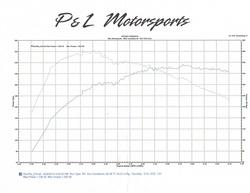
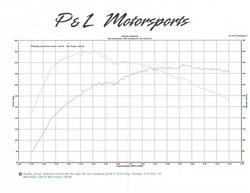
What type of dyno was it, and any printouts of the plot?
- Location
- Atlanta, GA
- Car
- 2007 FX35
280 is a little low for a stage 4 Stillen, but at 94 degrees, it's not out of the ordinary. Stillen's were never known for big, big power. Most of them don't go much over 300 and I don't think I've seen any over 350 whp. It's a positive displacement supercharger so it doesn't compress the air before the plenum. That means that as rpm's go up, the actual boost pressure drops a bit. This is different than a Vortech which compresses the air before it hits the plenum and hits max boost at redline. Also, they generate a ton of heat and even with the water/air IC, it's an issue.
Stillens produce a ton of torque down low, but as rpm's rise, that drops off so peak hp will always look low compared to a centrifugal supercharger or turbo. There will be a huge area under the curve though, so for stoplight to stoplight racing and moving around town, it's ideal.
I remember way back in '04 when Stillen first came out with the SC, a 350Z installed it and was getting tuned at my friend's shop at the same time I was. He put down 245 whp w/ Stage 1. I forget the torque number, but that was a bit higher. My turbo VQ30 Maxima put down 305whp. We were running similar boost ~7 psi. I remember looking at the graphs and his put down way more torque down low, but it didn't hold. Above 4k is when my hp curve passed his since the torque held much longer.
Stillens produce a ton of torque down low, but as rpm's rise, that drops off so peak hp will always look low compared to a centrifugal supercharger or turbo. There will be a huge area under the curve though, so for stoplight to stoplight racing and moving around town, it's ideal.
I remember way back in '04 when Stillen first came out with the SC, a 350Z installed it and was getting tuned at my friend's shop at the same time I was. He put down 245 whp w/ Stage 1. I forget the torque number, but that was a bit higher. My turbo VQ30 Maxima put down 305whp. We were running similar boost ~7 psi. I remember looking at the graphs and his put down way more torque down low, but it didn't hold. Above 4k is when my hp curve passed his since the torque held much longer.
Wait I am confused, I understand Dyno's measure very differently, and weather is a big factor, but isn't even 280 really low?
My car was measured at 257 with my NA engine. That is on a dyno which is locally referred to as "the heartbreaker".
Last edited:

- Location
- Miami
- Car
- 2004 Infiniti FX35 Supercharged

raymond
Member
- Location
- Netherlands
- Car
- FX35 RWD
A client of mine has recently mounted a stage 4 SC kit as well. I believe he runs around 380 at the cranck so should be around 340-350 at the wheel....maybe less as he has AWD. But he is happy with it. Wanted to be safe as he saw up close what issues i stumbled on to with the tranny. Haven't driven his car or seen it when done. Can't wait cause from the beginning i always looked into stillen as well. I think i will be sorry i went all the way for the minimum in performance differenece but the big difference in costs.......
- Location
- Atlanta, GA
- Car
- 2007 FX35
I believe European Dynos convert to crank hp, but the equipment is basically the same.
- Location
- Miami
- Car
- 2004 Infiniti FX35 Supercharged
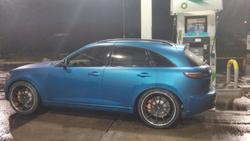
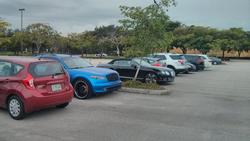
I'm back:smile (2):. Getting settled here in FL. Driving from WI to FL was a blast . Did some work on the FX, will post a big update in couple weeks.
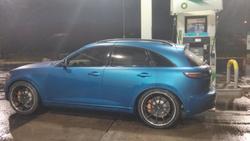
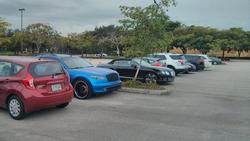

. Did some work on the FX, will post a big update in couple weeks.Attachments

raymond
Member
- Location
- Netherlands
- Car
- FX35 RWD
Sorry my bad missed the reply. Your correct LA....messured is done at the wheels. Often they add a certain percentage to calculate the cranck HP i believe. With automatic it was kinda hard to messure any HP due to the fact you have to disingage your tranny at the end of the run you make and then the dyno messure the hp. How is it done on your end guys....have to be honest don't know much about this at all and my engines keep blowing before i even get there
- Location
- Atlanta, GA
- Car
- 2007 FX35
The mechanical part of dyno's is pretty much all the same. Either weighted rollers or a stand that attaches to your cars hubs. Then your car spins them and the acceleration is converted to hp. Dynojets spin I think like a 1000lb drum and there's not much you can manipulate so they're pretty reliable for hp gains and such. Only downside is that if you tune on a dyno, you need to compensate for the street or track since the load is higher. So a safe AFR on a dynojet may be lean in real life. Mustangs spin a drum as well, but you can change the load to compensate. It's great to be able to adjust for things, but you can also make them lie. Input a lighter load or different car and all of a sudden, you have a 400hp stock Civic. I wouldn't put much faith in a Mustang for say a manufacturer's claims about performance gains for their intake. You can skew the numbers so much.
Then you have Dynapacks that attach directly to your hubs. You remove the wheel and then bolt stand to your hub. Supposedly takes out the variance in different wheels. In reality, a lot of people just like them because they read high. Great for internet bragging. Bottom line about all dynos is to stick with one type. They all work well, but if you get tuned on one type, then it would be best to stay with it otherwise you really won't know your gains and what's working and what isn't.
These days, it's easier to dyno an automatic. Just pick either 3rd or 4th depending on the car and you can usually use the manual shift mode to keep it there. Back when I had to dyno my automatic, there wasn't a way to lock it in gear so we could only get readings starting around 3k rpm. Otherwise, it would kick down a gear. As long as TC is locked it's not any different than a manual. We also had to make sure the car didn't upshift so we had to back off the throttle right before. Really don't want a full throttle shift on a dyno.
Then you have Dynapacks that attach directly to your hubs. You remove the wheel and then bolt stand to your hub. Supposedly takes out the variance in different wheels. In reality, a lot of people just like them because they read high. Great for internet bragging. Bottom line about all dynos is to stick with one type. They all work well, but if you get tuned on one type, then it would be best to stay with it otherwise you really won't know your gains and what's working and what isn't.
These days, it's easier to dyno an automatic. Just pick either 3rd or 4th depending on the car and you can usually use the manual shift mode to keep it there. Back when I had to dyno my automatic, there wasn't a way to lock it in gear so we could only get readings starting around 3k rpm. Otherwise, it would kick down a gear. As long as TC is locked it's not any different than a manual. We also had to make sure the car didn't upshift so we had to back off the throttle right before. Really don't want a full throttle shift on a dyno.
raymond
Member
- Location
- Netherlands
- Car
- FX35 RWD
Haha cause it would then jank of the dyno ?? I hope to get to a dyno soon probably would take some time again. Just did the first manual miles last saterday


Enjoy the warmer weather Zee.
Share: