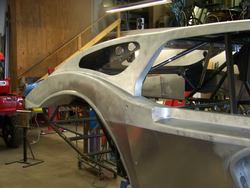
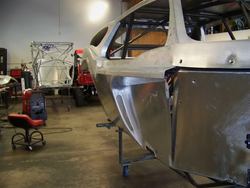
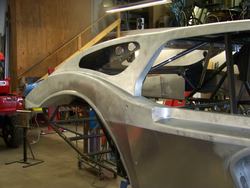
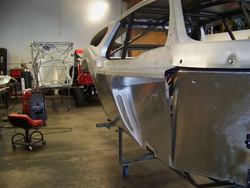
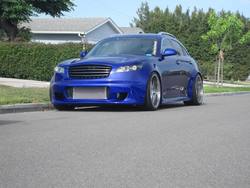
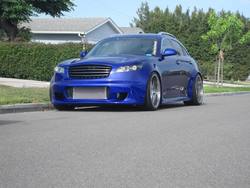
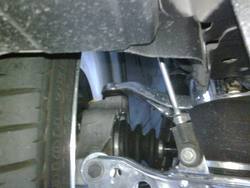
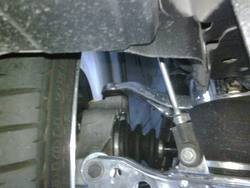
I'm glad to see that the bj angle isn't severe enough to bind, that's a good thing.
the problem with the angle of the control arm is not the ball joint though. the upper arm swings the ball joint up & down in a curve... it pivots on the inner mounting bushings & swings around it in an arc, of course not completely around in a circle but really just like that, just through a small portion of that circle...
picture this pivot point like the center point of a clock. lets say at ride height it is engineered for the arm to sit like a clock arm at 9 o'clock.... when the compression starts & the car goes down through travel, the clock arm goes from ~9 to ~10 lets say, so yes, the tip of the clock arm (ball joint)will also move in as it goes up, 10 oclock is "in" more than 9 o'clock, but not so severere, it's normal for it to swing that way & for it to come in a bit on compression. but now lets say that the vehicle is lowered so the tip of the clock arm now sits at a bit past 10 o'clock at ride height.... now, when the suspension compresses the arm pivots to a bit past 11 o'clock... 11 o'clock is really pulling the tip in, the difference in inward movement between 9 & 10 is much less than the difference between 10 & 11 if you see what I mean, taking it further to see the effects you can see at a more extreme that the difference between 11 & 12 would be the most severe, at that point the tip will be moving in more than it would even be moving up ... this is the problem, the more severe the angle of a short arm like our upper, the more it will pull in through travel...
the ideal solution is, if the car is dropped to where the arm is now at a bit past 10 o'clock, now leave the tip ( ball joint) exactly where it is, but move the center pivot point of the clock back up, bringing the tip (ball joint) out & back to where it was & making the arm back to ~ that 9 o'clock range.... now as it compresses it won't pull the upper bal joint in nearly as much
the only problem I could see with this approach for you is now the wheels wouldn't camber in as much as it did when dropped, & if your tire was close to touching the lip before it might then stick out to much & contact your body more if it came down more straight in your case... of course this would affect anyone with a drop this much, & while reducing the camber loss will improve the geometry it can also cause more clearance problems if you were counting on this loss of camber for clearance in the first place...
---------- Post added at 01:03 AM ---------- Previous post was Yesterday at 11:51 PM ----------
sorry man, but I'm a sucker for anologies to explain things by illustration... I just took a quick spin for a smoke & I realized that the tach in our dash is perfect to illustrate what I'm trying to show here, better than the clock analogy... just watch the tach... picture stock ride height upper control arm angle to be like at 1k rpm... now rev between 1k & 2k rpm, that's the swing of the arm as designed... the tip doesn't move in or out (left to right) much at all in this range, alls fine...
now hold the rpm's at 2k & picture this to be the new lowered ride height, & then rev between 2k & 3k as travel, it then is easy to see what is happening with the caster on a lowered fx... you'll see how much more the tip of the needle moves in( from left to right) as it goes up from 2k to 3k...
also want to mention that the lower arms are affected the same way, but since the arms are much longer the arch they follow is less severe & the change much less dramatic, not anywhere near as much of an issue like our shorter upper arms... so picture there movement to be like the difference between 1k & 1.3 k through the stroke of travel as opposed to the stroke of 1k-2k like our uppers... the longer the arm the less angle change for any given amount of travel...
---------- Post added at 02:28 AM ---------- Previous post was at 01:03 AM ----------
ahh, now that were into suspension geometry 101 just figured I'd add one more thing before I shut up... some may wonder why the designers even use a shorter upper control arm to begin with if it can cause the camber to increase on compression. this is done on purpose & it is designed to increase camber slightly on compression & reduce it on extension, this is because in harder cornering the outer wheel will compress with body roll while the inner will extend slightly, & this slight increase in camber on the outer wheel helps the outer tire to stay flater contact patch through the turn as the body rolls, also keeping the inner tire flatter as it extends... this is why independant rear suspension handles so much better than a solid straight rear axle car...