New rotors and pads Install

I also want to add that turning rotors is a dying trend. It's something that worked fine 30 years ago when people had very different driving habits.
Don't get me wrong, it still works today, but it's a band-aid. The metallurgical composition of today's rotors do not hold up being abused, turned, and then put back in service with the average driver. Once warped they will return to that state.
Look at these failures and ask yourself if you want to be driving down a mountain and have this happen. Sorry guys, but brakes and tires are what keeps me in control of my cars, so I find them VERY important.

brake rotor failure - Google Search
Excellent point, CriscoCracker re: turning rotors on modern cars - especially large high tech cars like the FX45 being yesteryear's methodology. I suppose ALL cars, FX or whatever, are "high tech" compared to the cars whose rotors we turned when we were youngsters. I am still kicking myself for not buying rotors when I put new pads on my wife's 2005 FX45 a few months ago. I think I was tired and not thinking clear because I had just finished replacing pads and calipers AND rotors on my 1998 Jimmy when I decided to do the Infiniti. I still had the Chinese dial indicator that I used on the Corvette a few years prior, but did not take the time to check rotor runout on the FX45. They all looked very smooth, but now we know that "smooth" does not translate to not warped or excessive runout.

Off topic a bit, I bought our FX45 new in 2005 and I never allowed the dealer to do the gas line and vent hose safety recall. At the time, I printed the procedure from my AllData DIY subscription and it was about 35 pages. Very complicated, removing much of the drive train, drive shaft, and a gazillion additional parts that escape me at the moment, just to access a couple of small hoses that may or may not have been made with rubber or material not rated for gasoline. At the time, rumor was that one Infiniti FX caught fire somewhere, perhaps around 2004. I guess the NTSB and Nisson could not be sure how many cars got the hoses with bad rubber, and of course they did the right thing to err on the side of caution and recall nearly every FX from 2004 to 2008. It has been many years since I studied this hose issue, so please don't take my word for exact model years involved and technical aspects of the hose.

My question to those who might be more familiar with this safety recall, since I am the original owner of the vehicle, is there a time limit on having a dealer make the repairs? I elected to NOT have the repairs done because it was a brand new $55,000 vehicle and I did not want the car darn near completely disassembled by a kid fresh out of vocational tech school to access a short hose that was probably not defective. Now, before everyone declares me an idiot (I could not make a good case that I am not an idiot) I am certain if the hose in question was going to be from the defective batch, it would have failed by now since I have owned the car for 12 years. If the hose fails, I submit that I would quickly get a Check Engine indication or an error code that I could read that would lead me to the hose.

Since that never happened in 12 years, I do not feel a clear and present danger exists. However, I figure I would have to allow the dealer to do the recall if I were to sell or trade the FX45.

Would the dealer have to make the repair no charge since I am the original owner? I think after each dealer did the fuel vent hose a few hundred times, Nisson streamlined the process so that the entire vehicle did not have to be disassembled, but I do not have direct knowledge of streamlining the hose repair. At the time, I did not wish to take the chance of a dealer creating other problems on my brand new car. After the local dealer had performed the recall on a significant number of Fx 45s, with hindsight I should have allowed them to make the hose repair. No doubt the Infiniti computer system would show a potential buyer that the safety recall had not been done.

My apologies in advance to forum administrators if I overlooked another thread where I should have posted this question, but I knew there were some smart guys contributing to this particular thread.
 
StopTech Program Manager. I'm not exactly on board with the statements made about rotor metallurgy and rotor behavior in this thread, so I thought I'd add a little industry experience.

No such thing as a warped rotor. Now THAT is a relic from 30 years ago. The metallurgy of today's rotors DONT WARP and actually turning the rotor has no impact on the metallurgy - it's making it thinner, not changing the grain structure of the metal.

Almost every single investigated case of what is thought to be a warped rotor is actually what we call Thickness Variation, due to uneven brake pad deposits on the face of the rotor. The rotor is not warped but has thickness variation on one or both sides of the rotor.

All brake pads have what we call adherent characteristics at particular temperature ranges. The entire point of bedding or burnishing brakes is to essentially get the rotor and pad up to operating temperature in order to "smear" an even layer of pad material onto the face of the rotor before being allowed to cool that way. It is the interaction of Brake pad/Brake pad material that stops the car, not pad/rotor, so with adherent layer technology the rotors essentially dont wear very much, they experience heat cycles. At other temperatures, brake pads can exhibit abrasive characteristics, so if a performance pad is driven on the street (lower than it's intended temperature range), the pad can remove the transfer layer off the rotor in an uneven way, resulting in a judder or vibration... which is incorrectly thought to be a warped rotor. All brake pads have both characteristics over a temperature range. This is why turning rotors works; it is removing the uneven pad deposits, not "unwarping" the rotor. This is also why re-burnishing the pad/rotor will often "cure" a warped rotor.

Similarly if a street pad is driven on the track, it will likely get too hot and deposit too much material in an uneven way on the rotor.

For these reasons, StopTech always recommends new pads and rotors at the same time for all performance applications. For street driving there is a little more freedom to mix and match used rotors and pads without as much chance of an issue - but bedding in brakes is always recommended with new pads and the success of that procedure will decrease the likelyhood of thickness variation.
 
StopTech Program Manager. I'm not exactly on board with the statements made about rotor metallurgy and rotor behavior in this thread, so I thought I'd add a little industry experience.

No such thing as a warped rotor. Now THAT is a relic from 30 years ago. The metallurgy of today's rotors DONT WARP and actually turning the rotor has no impact on the metallurgy - it's making it thinner, not changing the grain structure of the metal.

Almost every single investigated case of what is thought to be a warped rotor is actually what we call Thickness Variation, due to uneven brake pad deposits on the face of the rotor. The rotor is not warped but has thickness variation on one or both sides of the rotor.

All brake pads have what we call adherent characteristics at particular temperature ranges. The entire point of bedding or burnishing brakes is to essentially get the rotor and pad up to operating temperature in order to "smear" an even layer of pad material onto the face of the rotor before being allowed to cool that way. It is the interaction of Brake pad/Brake pad material that stops the car, not pad/rotor, so with adherent layer technology the rotors essentially dont wear very much, they experience heat cycles. At other temperatures, brake pads can exhibit abrasive characteristics, so if a performance pad is driven on the street (lower than it's intended temperature range), the pad can remove the transfer layer off the rotor in an uneven way, resulting in a judder or vibration... which is incorrectly thought to be a warped rotor. All brake pads have both characteristics over a temperature range. This is why turning rotors works; it is removing the uneven pad deposits, not "unwarping" the rotor. This is also why re-burnishing the pad/rotor will often "cure" a warped rotor.

Similarly if a street pad is driven on the track, it will likely get too hot and deposit too much material in an uneven way on the rotor.

For these reasons, StopTech always recommends new pads and rotors at the same time for all performance applications. For street driving there is a little more freedom to mix and match used rotors and pads without as much chance of an issue - but bedding in brakes is always recommended with new pads and the success of that procedure will decrease the likelyhood of thickness variation.
Do you have a certain bedding procedure you follow?

Sent from my SM-G935T
 
The short answer is yes - I follow the guidelines on StopTech's website. Here is a link.

StopTech Sport Brake Pad Bed-In Suggestions

The longer answer is that it really depends on the specific application, rotors and pads. Bedding for a street pad is different than bedding for a performance pad, but the idea is that you need to get the pad & rotor into the higher end of it's useful temperature range to allow the even transfer layer to occur... and then allow it to cool.
 
When I experienced brake judder (in the wheel), which got pretty bad, I tried to re-bed several times to no effect.
I ended up putting in new rotors and pads. felt like a fail too since I only had maybe 10K on my slotted Stoptechs.
 
StopTech Program Manager. I'm not exactly on board with the statements made about rotor metallurgy and rotor behavior in this thread, so I thought I'd add a little industry experience.

No such thing as a warped rotor. Now THAT is a relic from 30 years ago. The metallurgy of today's rotors DONT WARP and actually turning the rotor has no impact on the metallurgy - it's making it thinner, not changing the grain structure of the metal.

Almost every single investigated case of what is thought to be a warped rotor is actually what we call Thickness Variation, due to uneven brake pad deposits on the face of the rotor. The rotor is not warped but has thickness variation on one or both sides of the rotor.

All brake pads have what we call adherent characteristics at particular temperature ranges. The entire point of bedding or burnishing brakes is to essentially get the rotor and pad up to operating temperature in order to "smear" an even layer of pad material onto the face of the rotor before being allowed to cool that way. It is the interaction of Brake pad/Brake pad material that stops the car, not pad/rotor, so with adherent layer technology the rotors essentially dont wear very much, they experience heat cycles. At other temperatures, brake pads can exhibit abrasive characteristics, so if a performance pad is driven on the street (lower than it's intended temperature range), the pad can remove the transfer layer off the rotor in an uneven way, resulting in a judder or vibration... which is incorrectly thought to be a warped rotor. All brake pads have both characteristics over a temperature range. This is why turning rotors works; it is removing the uneven pad deposits, not "unwarping" the rotor. This is also why re-burnishing the pad/rotor will often "cure" a warped rotor.

Similarly if a street pad is driven on the track, it will likely get too hot and deposit too much material in an uneven way on the rotor.

For these reasons, StopTech always recommends new pads and rotors at the same time for all performance applications. For street driving there is a little more freedom to mix and match used rotors and pads without as much chance of an issue - but bedding in brakes is always recommended with new pads and the success of that procedure will decrease the likelyhood of thickness variation.

Thanks for the link to StopTech and the science associated with adherent layer technology.

Maybe someone else mentioned "warped" rotors and perhaps I missed it, but when I referred to rotor run-out, I would not consider run-out the same thing as a "warped" rotor - and I am in agreement with Jumbosrule that rotors probably don't warp in the sense of changing shape due to heat. Maybe we are splitting hairs, but my rotor problems with the Corvette were caused by the shop's brake lathe having too much wear or his lathe had a bad spindle bearing. It was a small neighborhood shop - not a dealer. He created 0.008" to 0.011" run-out with his lathe. Since GM specs allow only 0.002" run-out on the Corvette rotors, my low mileage rotors were now junk because even if I found a shop with a good lathe, the rotors would be too thin after turning them again. The run-out was cut into the rotors by his lathe, which was an expensive lesson for me. That was when I discovered most modern passenger vehicles' rotors are turned while on the vehicle during factory assembly. Feel free to correct me if that statement is incorrect, but as I understand it, many neighborhood shops, and surely most Infiniti dealers now turn rotors on the vehicle - because of induced run-out issues.

A few years later when I was installing brakes on the FX 45, I should have at the very least indexed orientation of the rotors to each hub, based on my ignorance of the previous brake job on the Corvette. I have not yet checked prices on Infiniti rotors, but if less than $30 or $40 per wheel, I'd probably replace the rotors rather than have the original 84,000 mile OEM rotors turned. Even though the original rotors look smooth on both sides, there might not be enough thickness left to turn the rotors within factory specs. I'm open as to the cause of the slight shudder with my wife's FX 45, but I'd almost bet the rent that I would have no shudder had I replaced all 4 rotors when I replaced the pads. I'm inclined to agree with CriscoCracker that replacing rotors makes more sense than turning rotors. Perhaps if we know for certain the shop's free-standing lathe cuts true and / or the shop turns the rotors on the vehicle, maybe a light clean-up cut of only 0.002" or 0.003" would be okay. I would probably not allow a shop to turn my rotors on a free-standing lathe unless he showed me his lathe was true with a dial indicator. If the shop has no dial indicator near the brake lathe, I'd go somewhere else. If the spindle on the brake lathe has only 0.0005" to 0.001" run-out near the spindle shaft, it will be exponentially more run-out at a radius of 8" or 10" (someone else can do the math for me).

At least the new pads got rid of the embarrassing brake squeal that prevailed since the FX 45 was brand new - and I used AutoZone's best lifetime warranty ceramic brake pads, that were frowned on in another post in this thread. I figure a major brake pad company makes pads for AutoZone, and AZ puts their name on the pads. FWIW - there was a factory service bulletin regarding the cold squeal to be repaired under warranty per customer's complaint. I think it had something to do with some of the extra metal shims and clips Infiniti installed on the factory brakes. It's a moot issue by now, but I could probably find the service bulletin if anyone wants to read it.

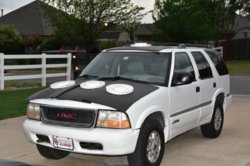
On a positive note, my wife continually asked me when I was going to get rid of the nasty rusty 24-pounds-each Corvette junk rotors that were ruined by the guy with the worn out brake lathe. Turns out I use the rotors quite often to hold soft rubber mats in place to minimize hail damage on the third vehicle that stays in the driveway during damaging hailstorms here in Oklahoma. I found a guy who had a powder-coat rig who was coating some white lawn furniture. He made me a reasonable offer to powder-coat the junk rotors. Now the rust does not run off onto the GMC paint or my hands during preparation for stormy weather. :)

A few weeks ago, the wind lifted one of the heavier 24-pound front rotors. I found it on the driveway the next morning, though the rubber mat was still in place on the hood (possibly adherent layer technology). :sneaky:

I'd hate to be hit by a 24-pound steel Frisbee if the winds get really rough.

Hail Protection 4-10-2016.jpg
 
Just replaced my R1 rotors for same reason but I got 30k out of them. Don't track like you do though. The shaking was terrible at the end; they were fine when cold but after a few miles they would shake hard enough to kick the steering wheel. Now new rotors are in and everything is perfect again.

Weird brake issues ever since switching to Akebono calipers - gone through rear pads every 10K now and when replacing the front rotors, noted that the pads still had most of the thickness. Relative to new pad, they're only 30% worn after 30K. Must be what happens when the brakes aren't quite balanced anymore F/R. But overall braking is much improved so I'll just live with it.

When I experienced brake judder (in the wheel), which got pretty bad, I tried to re-bed several times to no effect.
I ended up putting in new rotors and pads. felt like a fail too since I only had maybe 10K on my slotted Stoptechs.
 
Just replaced my R1 rotors for same reason but I got 30k out of them. Don't track like you do though. The shaking was terrible at the end; they were fine when cold but after a few miles they would shake hard enough to kick the steering wheel. Now new rotors are in and everything is perfect again.

Weird brake issues ever since switching to Akebono calipers - gone through rear pads every 10K now and when replacing the front rotors, noted that the pads still had most of the thickness. Relative to new pad, they're only 30% worn after 30K. Must be what happens when the brakes aren't quite balanced anymore F/R. But overall braking is much improved so I'll just live with it.
I read that the Electronic Brake Assist in our FX's hit the rear brakes more when the sense the front end is dipping during breaking... So probably the added grip in the front causes it to want to dip more, making the electronics hit the rears even harder to balance out the dip and killing the rear pads...
 
Back
Top