What to change about the internals when going forged

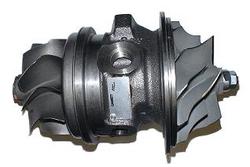
Not what I mean, just talking about the turbo itself. If you look on a journal-bearing turbocharger it'll just have an oil inlet (high-pressure feed line) and an outlet on the opposite end (low-pressure oil drain or return). On a ball-bearing unit there will be 2 additional perpendicular holes for coolant to pass through the center section.

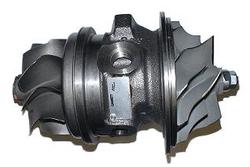
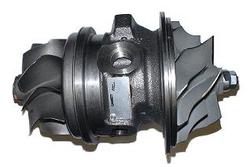
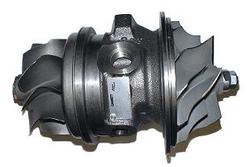
The picture below shows a Garrett CHRA (like a GT35R) with the oil feed at the bottom, the middle is one of the coolant holes, and at the top rotated out of view is the oil drain/return. I don't know why they took the picture this way but this is the exact opposite of how it should be mounted in the car.
CHRA.jpg
 

Attachments

  • CHRA.jpg
    CHRA.jpg
    11.5 KB · Views: 30
Last edited:
Not what I mean, just talking about the turbo itself. If you look on a journal-bearing turbocharger it'll just have an oil inlet (high-pressure feed line) and an outlet on the opposite end (low-pressure oil drain or return). On a ball-bearing unit there will be 2 additional perpendicular holes for coolant to pass through the center section.

The picture below shows a Garrett CHRA (like a GT35R) with the oil feed at the bottom, the middle is one of the coolant holes, and at the top rotated out of view is the oil drain/return. I don't know why they took the picture this way but this is the exact opposite of how it should be mounted in the car.

CHRA.jpg

I want to point out one thing. Just because it is a journal bearing turbo does not mean it is not water cooled. The k04 turbo that came stock in my old mazdaspeed6 was a journal bearing turbo that was water cooled.
 

Attachments

  • CHRA.jpg
    CHRA.jpg
    11.5 KB · Views: 35
Sorry, should've clarified. Between the 2 turbos you have that is the case, but pretty much every factory turbocharged car after the 80s will be liquid cooled even though they're journal bearing. My '91 Mitsubishi Eclipse GSX and '01 VW GTI were also liquid cooled, as are new Evos, STis, etc.

The reason being turbo cars got a bad rap for not only turbo lag (waiting for the turbo to spool until it hit full specified boost and the power finally "kicked in") but also reliability issues from failed units due to coking, or leftover oil in the turbo heating up after engine shutdown (oil no longer circulating through the turbo) and leaving deposits within the lines that eventually blocked the lines and caused a failure.

Letting the car idle for a minute or two before shutdown helps with this (that's where turbo timers come in but that's another subject) but liquid cooling and advances in engine oil technology are even better preventive measures to keep coking from happening.

And to further clarify, not all ball-bearing turbos are liquid cooled. Garrett makes a TR30R turbocharger only available to race teams (WRC and LMP, at a cost of $8000-$16,000 depending on how it's configured) that has ceramic ball bearings and is oil-cooled, and Turbonetics just released a line of their own ceramic ball-bearing units that are available to the public (at a much cheaper price I'm sure).
 
Last edited:
ouch, would find a new block, you may need to have it sonic tested, the stock walls will more than likely be distorted, even with torque plates, may have inconsistencies in wall thickness.
Would say 97.0mm pistons, at this point, would be nice to have 96.0 from stock 95.5mm rods, check condition, replace as needed. ACL race bearings, have crank checked and polished as necessary. Worse case scenario, sleeve it with Darton MID Sleeves and go 100mm :) keep stock rod height, get a Pauter or K1 rod set, have them balanced.
Assembly is the key to success.

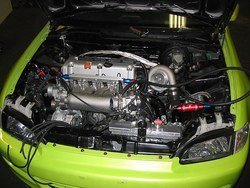
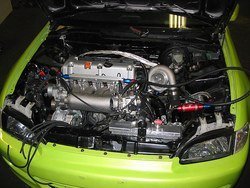
Compression ratio, 9.2:1 CR has been real boost friendly, as I have tried 10.1:1 and 8.5:1, it will all boil down to tuning, make sure tuner is familar with ignition timing, that has produced for me insane low end, nearly eliminating lag even in a 4 cyl turbo. I've seen boost @ just under 3000rpm and climb to a boost cut @ 11psi just before 5500rpm, due to stock MAP sensor, this was done at 70% throttle. on this car:
3289131858_dd9c6fecc7.jpg
All boiled down to tuning.

My Sentra sees boost @ just over 2500, by 4000rpm I am already in the 10psi range, by 6000rpm shooting past 17psi, by 8000rpm peak holding steady 22psi, Precision SC61 w/ PWR A2W IC setup.
25702790117_large.jpg


If your tuner is not familiar with certain aspects, I know the right person to assist you, but you will pay for his time, my own mentor Chris Macellaro
 

Attachments

  • 3289131858_dd9c6fecc7.jpg
    3289131858_dd9c6fecc7.jpg
    61.7 KB · Views: 27
Thanks will look into it and notify the guy who will do this for me. Thing is that i'm not planning on making this a to big projekt. That is due to lack of retailers here and knowledge a lot has to come from overseas and do not want to lett this run into high cost numbers.
Everybody has got a thing wich is most important for them. Some engine....others sound....others styling......
You are really into the engine tuning and then only the best is good enough.
Don't get me wrong as i do not want any engine blowing as well, but i'm staying at the base as where you guys really create crazy numbers were you need to take 100% care of things :glasses:
 
We have plenty of international clients from all over the globe, RPM NYC specializes more to the Honda crowd, as we have been in the industry for nearly 15 years, constructing the fastest Hondas years ago. I came aboard to assist with Nissans from my prior experiences with Maximas and VQ motors in general. I've gone into detail with RB, and SR motors since joining the crew here. If you need something, feel free to contact us.
 
Rookie,

I´ve messured the down pipe and was 2,75 inch > 70mm got the versions with the Catalystic as that is neccasary here in the netherlands.
Would the increase to a 3 inch downpipe help that much....??

And what about that cat.....as that will stop flow as well then.....
 
The TN kit had piping limitations, that and the turbo/aits are hot. Larger downpipe would help with top end back pressure but if you have a cat it's sort of a mute point. Is there a yearly inspection or something in your country?
 
The TN kit had piping limitations, that and the turbo/aits are hot. Larger downpipe would help with top end back pressure but if you have a cat it's sort of a mute point. Is there a yearly inspection or something in your country?

Turbo/aits....?? I'm sorry but there is where my tech english stops :embarrassed:

Yes we have a yearly inspection on wich the Fuel Mixture/ O2 is messured so we really need a Cat.
But i was being lazy as i can make something wich can be mounted and taken of again. But at first thinking it would be a mettalic cat it wouldn't have too much negative affect and saved me additional work each time. But now i am doubting if the TN Cat is mettalic as well as far as i can see.
 
Rookie,

I´ve messured the down pipe and was 2,75 inch > 70mm got the versions with the Catalystic as that is neccasary here in the netherlands. Would the increase to a 3 inch downpipe help that much....??

And what about that cat.....as that will stop flow as well then.....
Turbo AITs - Air Intake Temperatures. I think what Rookie was saying is that the Turbonetics kit produced higher AITs, making it less efficient and more prone to knock.

My exhaust is 3" from the turbo all the way to the Stillen merge collector, where it splits to dual 2.5".

I do not have a cat in my setup. If you MUST include the cat, then stay with a high flow design to keep that restriction to a minimum. Yes, the cat will restrict the flow of exhaust but with your new found turbocharged power, it is the difference in only a few whp. You won't know the difference without comparing/feeling the two side by side. I believe the second point Rookie was making is that if you have to use a Cat, then there is no advantage of switching to a 3" downpipe.

Have you already purchased the turbo? I ask because Garrett now has the GTX series, which spools up 700rpm faster than the same size GTR series. I can't complain about lag from the GT35R, but there would be more power more quickly with the GTX series and you should not have to change anything about your system design.

The other alternative is the new Borg-Warner turbos that came out at SEMA this year - they have wastegate, BOV and boost control all integrated into the turbo unit - no separate components to purchase or to route vacuum lines to, etc. Check it out!
 
Back
Top