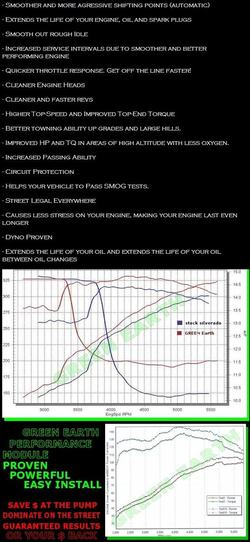
Pulled directly from that eBay auction you referenced:
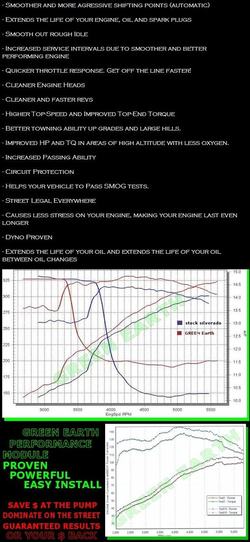
Notice the right hand column of the first graph... AFR changes from 10.25 to 11.5 (it's the red and blue line that start out at the top left and end up at the bottom right)
The reason for this steep drop is because when cruising, your ECU wants to maintain as close to stoich (stoichiometric) which is roughly 14.7 parts air for 1 part fuel, or 14.7:1
Under heavy load (flooring the gas pedal or climbing a steep hill, etc) this stoich mix can easily lead to detonation, which is why the ECU, upon sensing your foot slamming the pedal, will dump an over-compensating amount of fuel through the injectors to not only match the new throttle position, but overcome it to avoid detonation under these high loads.
Your gas pedal only changes the position of the butterfly valve in your throttle body (whether by wire or cable... the VQ motor and most newer motors use what's called drive-by-wire, where an electrical signal repositions the throttle instead of an actual cable connecting the throttle to your gas pedal) and the MAF (mass air flow) sensor sees a surge of air and tells the ECU, which in turn signals the injectors to increase flow.
The O2 sensors also read out the resulting AFR from the exhaust (in our car these O2 sensors are in the headers) and give feedback to the ECU to let it know that there's been proper fuel added for the extra surge of air. Another set of O2 sensors at the end of each cat simply tells the ECU that the catalytic converters are doing their job in lowering emissions. These do not affect the operation of the motor in any way, but rather give a fault code if it doesn't see the catalytic converters doing their job.
So, to sum it all up, you're leaning out this mixture that Nissan engineers have spent thousands of hours perfecting to ensure longevity of your motor. These "Green Earth" guys spent $0.74 on some wiring, resistors and a neat sticker to go on their plastic case that just leans out your motor.