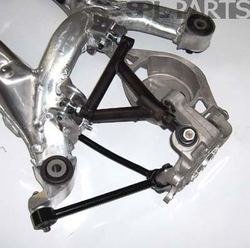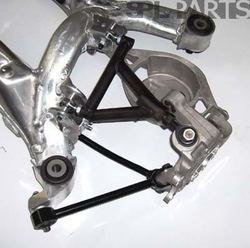
modified struts & suspension

I dig what you're saying.

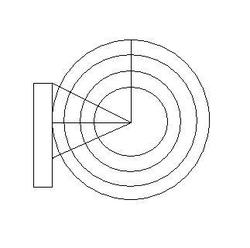
This is a crude drawing.
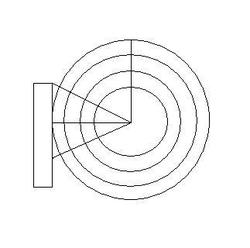
uca_1.jpg

Rectangle is the knuckle and ball joint. You're only speaking of the binding happening at the ball joint, there's binding happening at each of the bushings at the upper control arm at the sub-frame, and each of the bushings at the knuckle and sub-frame points for the rear lower link (spring bucket) and front lower link (shock arm).

The natural position of the bushings is very important, or you end up transferring more of the load to other parts of the suspension and body.

The spring or in my case the bag applies load up to the mount, whether this is twisting or compression load. Mine will twist a little, where the spring should not twist much or you got bigger problems than camber angle.
The shock applies load up to the upper mount, whether this is twisting or compression load. Upper mount has bushing to take some angle changes.

My suspension when we took it all apart. And I mean all apart subframe down, solid diff mounts put in, and the HKS shocks in the back was reassembled and torqued down in this natural position not the "stock" position. Control of the travel with the HKS shocks is worlds better than oem. I have less down and less up travel since the shock is shorter. It is a mono tube, with internal bump stop, minus the bump stop my tire would rest on the wheel well arch when fully dropped.
 

Attachments

  • uca_1.jpg
    uca_1.jpg
    11.2 KB · Views: 16
ok, I do get what your saying, but I'm not only speaking of the binding happening at the ball joint... I'm actually not speaking about binding at all really, I'm talking strictly about the geometry of the suspension & how it is affected by the drop... the fact that it can bind at this extreme drop is a side effect of the incorrect geometry..., I'm not really talking about correcting the binding issue which is a side effect, cause that will not help the incorrect geometry which is the real problem, I'm talking about correcting the geometry itself & this will also have the side effect of avoiding this binding.... ideally I'm looking to cure the problem & not just compensate for the side effects

we have an unequal length dual wishbone suspension in the rear. this is a great setup cause it is designed to keep the rear wheel at the correct camber & keep the tire flat to the ground throughout the suspension travel & body roll as it is designed. the problem is, when you drop this thing several inches & more you are killing this geometry, you can compensate for the negative camber at ride height by pulling the lower arms in with a caster kit, but this does nothing to actually correct the geometry throughout travel & body roll, & the real problem is that the wheel will have much more negative camber added as it compresses than it should...

ok, so now heres my own crude illustration to try to show what I'm talking about...


first, this is stock height, correct geometry:

1


now this is stock height, correct geometry under compression:

1


now this is what happens when you drop it, at ride height:

1


and this is dropped, with camber correction at the lower bolts, notice the pivot point is altered at the inner lower mount, this is done with the off center bolts:


1


but now this is the lowered height compressed, even after the correction done to the lower inner bolts. notice how much more camber has changed with the same amount of compression as shown in the first stock pic's

1
 
Last edited:
here is a side by side to see the difference in camber from the same amount of suspension compression, even though they both had exactly the same camber at ride hieght:


1


all of these diagrams were done using the correct pivot points for the diagrams & are pretty acurate representations of actual, although the scale is not acurate...

in a bit I'll show what I'm talking about to correct this problem....
 
Last edited:
I think all cars with the same type suspension will suffer from the same thing when dropped, but I think the fx will be even more affected & more severe of a problem because of how much it needs to be dropped. a sedan may be nice with a 1" drop, a 2" drop would be pretty low, but the fx still sits a little high with just a 2" drop, that's about where I am now. when it goes to 3" & 3 1/2" or more it really compounds the amount of change & the camber really goes away at a much higher ratio to compression at these lowered heights because of the geometry...

cars can live with this drop easier than a thing like the fx that needs to come down almost 4" I think, even though cars can have problems too, the fx could be worse I think... my rear tires are like $800 a pair & I want them to last at least 25k miles or more if they can :tonguey:

I want the wheel to track well through it's stroke & to try & keep the camber as close to the way it should be as possible.


ok, so as I see it, the biggest problems of a car like the fx dropped pretty low in the rear is mainly 3 things?:


1) the suspension may bind as it aproaches full drop...


2) axle length & proper compression, extension & axle engagement needs to be accounted for. can the axle hit the frame at full compression? looks like it might be close...


3) the camber will become too negative as it compresses through it's normal stroke & travel because of the improper geometry, as the fx goes down the wheels will have exagerated aditional negative camber


________________________________________________________________


like you said, the bushings have to be tightened in the right position to allow them to flow through the stroke required in use. if you tighten in the wrong position, like with the arm all the way down lets say, then the bushings will have excessive twisting force on them. they are not bearings, if you twist them too much they can bind & they can even rip. a lot of mechanics screw this up too btw from what I've seen :smile:

I don't know if there is any other inteference for the arms or the axle, can they bind or hit on anything else?


how I think this can be done best is, instead of (or even in combination with) relocating the lower inner pivot of the longer lower arms like a normal camber kit does, relocate the shorter upper inner arm pivot points like this, bringing it closer to the angle it's designed to be at:


lowered ride height, upper arm pivot point raised:


1


and compressed. camber change less, more like it would be at factory ride hieght:

1


now, the last question is, is there enough room for this? even if it couldn't come up 100% as much as necissary, it could be brung up as much as possible, & then out a bit too, helping 50% is better than 0%... would be ideal to be able to bring it up as much as it would need to be correct though... gotta get in there & see...
 
Last edited:
def needs to be strong, as long as the mount is strong there is no additional stress, if anything it's relieving stress that would have been there before this was done...
 
what ever don't fit can be made to fit, that's why there called modifications :tongue:

might take some floor/frame work... not saying it will be easy but might be doable...
 
couldnt you shorting the lower arm instead? or drilling new holes closer in? to get the same geometry of the relocated upper?


----
never mind, I saw you covered that..

...but how about new holes near the wheel (lower mount) vs relocated holes on the body side.

---------- Post added at 07:03 PM ---------- Previous post was at 06:54 PM ----------

View attachment 172310

(but the ball joint would be more stressed vs your idea)
 
Last edited:
ok, the above stuff I illustrated & wrote myself, cause it's specific to the fx & what I am trying to show in our case & because of the drop, but the following I copied & pasted, cause this is readily available & documented information already & I want to show why this camber change being correct to the geometry of the suspension is so important to handling & drivability. I only illustrated the effect on one wheel, but when you look at both at the same time the way they should be you can see more why this really matters. this stuff was stolen from here:

http://www.autozine.org/technical_school/handling/tech_handling_2.htm


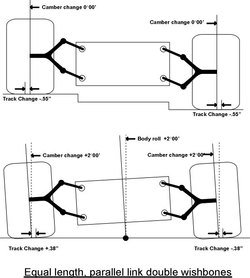
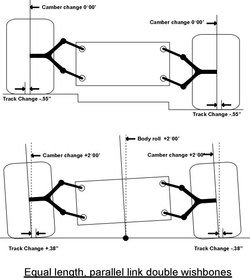
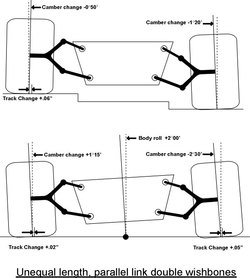
  • [FONT=Arial,Helvetica][SIZE=-1]To maximize cornering grip, the suspension must keep the tyres perpendicular to ground under all conditions such as bump and body roll so that the contact patch area remains maximum.[/SIZE][/FONT] [FONT=Arial,Helvetica][SIZE=-1]Generally speaking, double wishbones suspension does the best job to keep the tyre perpendicular to ground. The below figure shows how the conventional double wishbones suspension deals with bump and body roll. You can see there's no camber change at all under bump.[/SIZE][/FONT]
    double_wishbones1.jpg
    [FONT=Arial,Helvetica][SIZE=-1]But the scene changes very much under body roll - camber changes for the same degree as the body roll. Track width also increases. Camber change reduces the contact patch area thus grip, and also introduces non-neutral steering (we'll discuss this later). Track width variation forces the tyres to slip thus also reduce grip.[/SIZE][/FONT]
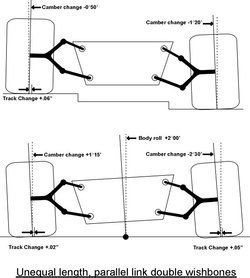
  • [FONT=Arial,Helvetica][SIZE=-1]Therefore engineers invented unequal length double wishbones. As shown in the below figure, the variation in camber and track width are largely reduced under body roll, although there is a small trade-off in wheel control under bump.[/SIZE][/FONT]
double_wishbones2.jpg


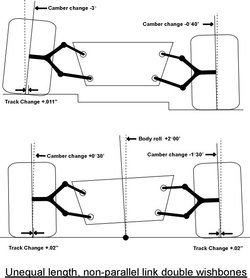
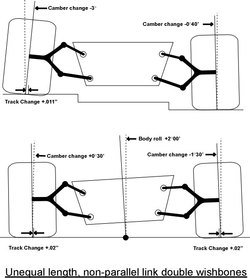
  • [FONT=Arial,Helvetica][SIZE=-1]Unequal length non-parallel double wishbones (below) is even more impressive, whose camber angle at the heavy-loaded outside wheel is nearly unchanged, although it is less good under bump.[/SIZE][/FONT]
double_wishbones3.jpg

[SIZE=+4]Handling[/SIZE]


  • [SIZE=+4]Cornering Speed[/SIZE]
  • [SIZE=+2]3. Weight Transfer due to lateral force[/SIZE]

    [FONT=Arial,Helvetica][SIZE=-1]When a car is cornering at speed, the car's weight transfers from the inside wheel to the outside wheel. The rate of change is proportional to the height of center of gravity (CG), the lateral acceleration ( in g ) and inversely proportional to the track width. As this :[/SIZE][/FONT]
    • [FONT=Arial,Helvetica][SIZE=-1]Weight transfer = ( Lateral acceleration x Weight x Height of CG ) / Track width[/SIZE][/FONT]
      [FONT=Arial,Helvetica][SIZE=-1].[/SIZE][/FONT]
    [FONT=Arial,Helvetica][SIZE=-1]For example, a Porsche Boxster is cornering at 0.85 g. Assuming its track width is 1600 mm, height of CG is 500 mm and it weighs 1250 kg, then we can calculate the weight transfer is 332 kg. Assuming the car has a perfect 50 / 50 weight distribution between front and rear, then we can see each inside wheel takes 146.5 kg while the outside 478.5 kg. What a big difference ! Therefore you can see the outside wheel has far more influence to handling than the inside wheel. This explain why we prefer unequal length non-parallel double wishbones, because it has the least camber change on the outside wheel.[/SIZE][/FONT] [FONT=Arial,Helvetica][SIZE=-1]If the car corners at extremely high g-force, our calculation may find the weight transfer approaching half the weight of the whole car, this means the outside wheels take all the load while the inside wheels are virtually unloaded ! [/SIZE][/FONT]
____________________________________________________________end of copy/paste


btw, we have the Unequal length non-parallel double wishbones in the rear of the fx...

---------- Post added at 01:26 AM ---------- Previous post was Yesterday at 11:58 PM ----------

another thing to add for anyone still following this so far :tonguey:


by dropping the fx over 3" the geometry goes way out of whack. raising the upper arm inner pivot point equal to the whole amount of drop is not a good idea, cause the drop also threw off the geometry of the lower arm too, just not as much. if you 100% corrected the upper arm angle at ride height while dropped this low to the angle it's at stock, you'd actually wind up with the opposite problem. the lower would now come in more than the top as it compresses & instead of too much added negative camber to compression ratio you'd now have too little. the trick is going to be the right amount of raise of this pivot point

I haven't determined that but it might be like 40% the dimension of the drop... gotta do measuring & calculating to know exact though, so rough guesstimate like 1 3/4" raise of the mount on the frame for the inner upper arm give or take maybe? even a 1 1/2" raise would do wonders to correcting camber problem with the drop.


there are software programs out there that can actually model the suspension & really help determine the ideal spot too but I don't know anything about them really... it can be done just with measuring & math though, just like you could determine a sub box spec with the numbers & math, although box software is a huge convenience, to just do the fx software isn't necessary, but I'll look around & see what I see there anyway I guess

I stuck my head under the wheel well & took a peak & from how it looks so far, folding the pinch weld up alone can offer some clearance. past that the frame/floor member can be compressed in to gain slightly more clearance. that's a nice way of saying beat the crap out of it with a heavy hammer & dent it in. to do much more than that would be like cut & weld, make a pocket like a "c" notched frame. that for sure would be enough to be able to get the geometry right from what I see so far.


then there's the option of mounting the upper arm on the frame/body instead of the subframe itself.. I don't think that would cause much problems, maybe slightly more road noise transfer... doubt the lower subframe moves around enough for it to matter if the arm pivots off the frame instead of the subframe. the good thing about that approach is instead of dealing with aluminum bracing & extending the aluminum mounting tabs up & reinforcing them to the subframe, it would all just be steel & welding work... adding a "c" notch like this may seem a little extreme, but it may be the best way to get the suspension right while riding 3 1/2" + lower than stock. many manufacturers mount upper arms to the unibody while having the lowers on a subframe, this may be the best way to do it

picture a steel pocket with arm mount tabs already on it, completely replace the upper mount with this, cut out the metal in the frame member right in front of the upper spring seat, enough to fit this pocket in & weld it in. the pocket itself would be heavy steel & become the notch & the frame reinforcement as it's welded in to the body of the fx. wanna go nuts then brace between the 2 new upper arm mounting pockets, either above.below or through the floor depending...


now is all of this worth it? to go 3 1/2" drop in ride height? depends how right you want it to be I guess?. also depends how bad the alternative would be, by just doing the standard offset camber bolts & leaving it at that, & not correcting this.... I'm not sure myself, but I think it might be worth it... the only other one at this ride height now is you rookie, from what you see do you think the camber is enough of an issue to do something like this about it?
 

Attachments

  • double_wishbones1.jpg
    double_wishbones1.jpg
    46 KB · Views: 33
  • double_wishbones2.jpg
    double_wishbones2.jpg
    48.3 KB · Views: 20
  • double_wishbones3.jpg
    double_wishbones3.jpg
    49 KB · Views: 30
lol, no I don't. The camber is not as extreme as you're thinking. I haven't gotten an alignment in years, got one once after the airbags and have since just eye balled the wheel position. Since widebody, this is only my 2nd set of rear tires. Have always set the camber to max and toe to be fairly straight.

Our configuration is prone to more camber on full compression vs the G/Z due to the shock position on the arm vs shock mounted to the knuckle on the G/Z. They put more stress on their upper shock mounts.They spec 1.25 nom camber up to max of 1.75, while we're .80 nom to 1.30 max. I've seen bagged G/Z and their rears do not camber as much as mine. But this is all the way down I'm talking, and if I were able to compress it all the way down while driving I'd be worried for my safety as that's a lot of travel down.
 
I'll read that post after but that's good to hear cause what I have in mind would be a major pain in the ass for sure :tongue: maybe I'm worrying too much about how bad it might be... just a camber kit would be much easier :laugh:

how did the tires wear inside compared to out, did they wear more inside or ?
 
It was pretty flat, cause on the longer road trips I would ride at a normal height. No crazy drop unless we got to some twisties and I'd drop it down a little.

Tire wear was inside once I started riding lower, my tires are 350 or so each. Lower felt better on the twisties for sure.

One thing of note. When we first went widebody. I had no real option on the camber and toe. Once we corrected the camber but couldn't do the toe until the bolts came in the ride was wack. Corrected the toe, and got alignment still felt a little funky.

Only after adding the GT Spec bars did it feel great again. One thing of note that this topic probably expounds on is camber in relation to offset. Lower offset adds negative camber when negative camber is present. For me to be as low of an offset as I am and not be crazy tilted is a good thing.
 
yeah, the wheels sticking out more with the negative offset must create leverage that adds to neg camber I guess too.

I read that thread with the control arm... funny stuff there, don't look so hot functionality wise at all to me, it looks dangerous & scary to me actually:smile: it does nothing that moving the lower doesn't do. it has no change or correction for the difference in geometry.

well, at this point, I do think that the negative camber will increase proportionately higher with the drop & on compression, scientifically it has to, but from your experience & use it seems that it may not be bad enough to be a problem. so I guess I'd just try the camber kit & see how it goes for me. any idea where the camber & toe bolts can be gotten? save me the fabricating my own if I can find anything readily available....
 
There are a few companies that make rear upper control arms with adjustment like that. A few are plates like that while others have joints to do the adjustment. I'd take that coupled with adjustable toe arms if possible.

I found this a long time ago during my quest to see what else was out there.
DSC00207.jpg

I think it's from a Is300.

I can't remember which of the point needs the longer bolt. I have my old subframe in the backyard, will measure it tomorrow.
 

Attachments

  • DSC00207.jpg
    DSC00207.jpg
    63.8 KB · Views: 25
Here's another upper control arm.
SPLRCAZ33Proto.jpg

If you notice the bushings for the subframe, are opposite. Rears are pressed in one direction fronts pressed in the opposite. The subframe somewhat pivots.
 

Attachments

  • SPLRCAZ33Proto.jpg
    SPLRCAZ33Proto.jpg
    36.1 KB · Views: 19
well, my race car fabricator just called, my modified arms & struts are done, pick them up in a bit....


building an upper arm for the fx can be done with rod ends like that I guess, having the upper adjustable is good in a way cause it can adjust camber without affecting toe at least, good rod ends are cool but that plate design of that first arm looked scary & not as secure. I'm assuming no one makes an adjustable upper arm specific to the fx?


as you correct the camber with the spring bucket arm the wheel will toe out at the same time, this should be corrected by adjusting the front arm that the shock rides on right? there should be no need for any variation in the forward lateral bar from what I can see, right?


I still can't help but thinking that raising the upper arm inner pivot points would be a good way to go to correct the camber through the whole stroke & not just at ride height, but def looks like a very complicated thing to do. from the way the bushings are on the subframe & from what your saying about it pivoting a bit, mounting the upper arms on the frame instead of the subframe may not be such a hot idea afterall... guess the upper arm should at least stay on the subframe...
 
Forward bar is fine, our stud is larger than the G/Z so their aftermarket ones won't work without changing out the bearing and or ends.

Yeah camber and toe is give take.

Now when I say it really cambers in when fully deflated. When my bag is fully deflated, it allows the spring bucket to go in any direction it naturally wants to go. At no point would a spring ever articulate the way a deflated bag would. Yes it will give some as it's compressed but the coils won't ever twist that much to make the camber uber nasty.
 
Back
Top