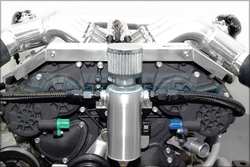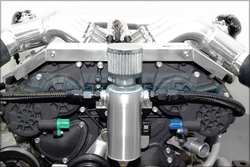

So over the past few years of FX ownership, I've experimented with a few oil catch can designs. I'm currently on my fourth OCC, but feel like I have finally figured it out for both NA and FI applications on the VQ35DE. I've put together what I wish I had when I first started reading up on the OCC and all the different ways it can be used.
First, let's start with what an OCC is and why it's a good thing to have.
The VQ35DE engine (and the majority of other modern engines) employ what is known as positive crankcase pressure. This comes from the fact that the combustion process inside your cylinders leaks a little. The piston rings have a gap in them and blow-by gasses push through these gaps and up into the valve/rocker covers. The blow by gasses are comprised of everything that the gasses come into contact with along the way. Air/fuel mixture, exhaust gasses, oil and a small percentage of coolant as well. Oil is usually the highest contributor to blow by gasses.
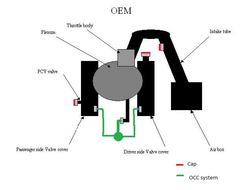
The OEM design vents these gasses out of the valve/rocker covers through the passenger side PCV valve and the driver's side valve cover vent, located under the Throttle Body. In addition, the two valve covers are connected by an interconnect hose to make sure the pressure inside each valve cover stays equal. See find #1 (three locations)
View attachment 226455
The two valve/rocker cover outlets are routed back into the intake tract, so that a vacuum is pulled and the gasses flow back into the plenum to be burned in the cylinders. The only problem is that these gasses leave a trail of sludge behind them. If you have ever opened up your plenum, you see the oil stains and sometimes even small pools of oil inside the plenum. This is the definition of oil sludge.
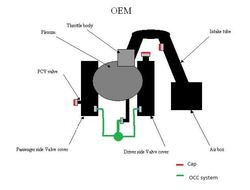
Here's a diagram of the OEM system under your hood.
View attachment 226457
Now obviously the manufacturers don't consider this to be a threat to the long term reliability of the car. Yes, it's a little messy over time but there is no immediate danger to the car or any of the systems. After a lot of miles, the intake would need to be cleaned out. Not doing so would begin to rob you of efficiency (mpgs). So installing a catch can on a stock VQ engine is only going to be a "nice-to-have". Not necessary, but appropriate for FX enthusiasts who want to go the extra step for their car.
There are actually quite a few ways you can attack the install. This was one of the things that was very confusing for me because everybody seemed to have a system that was different from everybody else. I've sketched out the most common designs, and I have recommendations for which ways are best and why.
First up is what I would recommend for any NA FX of any generation. Both valve/rocker covers hoses are routed to the catch can inlets and a single vacuum sources is hooked in, allowing you to cap the other vacuum port in use with the OEM setup. I purposefully used the larger 5/8" hose attached to the intake tube for the larger diameter, instead of using the smaller diameter hose as the vacuum source. This is my number 1 recommended setup. It uses the OEM size fittings and hoses.
View attachment 226459
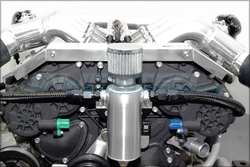
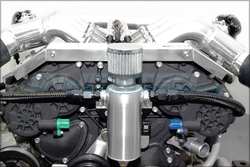
Here's a photo of the above design in action in my FX. The circled area is showing where I capped the vacuum port on the plenum.
View attachment 226461
Photo from the other side of the OCC. The vacuum hose is routed to the driver's side...
View attachment 226463
And it attaches to the port on the intake tube.
View attachment 226465
These next options are really variations on the same theme. This one uses the smaller hose as the vacuum source so IMO would not be as ideal. Would probably still work just fine and might be the way to go depending on where you plan to place the OCC in the engine bay.
View attachment 226467
This method uses a T-fitting to join both valve cover outlets into a single source for a can that has only one inlet. IMO this is too restrictive. I did try this for a while and could actually hear the system sort of "depressurize" as I turned off the car.
View attachment 226469
The next variation is actually two OCCs - one for each side. This would be my second recommendation for any generation FX in terms of cost. It would be my first choice for the best performance/efficiency setup.
View attachment 226470
Finally, there's a breather setup. Not CARB or emissions legal, but common with Forced Induction platforms, which have greater blow-by in general. This setup includes drilling out the PCV for free flow (removing the one way valve).
View attachment 226472
This is my current breather setup, for use with a Forced Induction platform. I'm using brass breathers rather than the normal air filter media breather you might see.
View attachment 226475
Another breather setup I really liked (also on a forced induction motor). This one has the air filter media breathers.
View attachment 226476
So now you know what an Oil Catch Can does and how it might be installed. What are the important things to remember about selecting a can and the rest of the parts?
Restrictions are bad. The smallest opening in the system is what limits the flow of gasses to the can. Pick a can that has fittings matched to your hoses - or larger. This is also a reason I didn't like the T-fitting options. The T-fitting itself is a restriction as well as reducing two hoses into one.
Taking this vent concept to the extreme - I have seen OCC setups that add two to three more vent lines off each valve cover, insuring free flow. The OCC has 6-8 inlets and then either a vacuum source or a breather. Example:
http://www.t1racedevelopment.com/index.php/en/products/details/89/1/catch-cans/t1-crankcase-catch-can.html
I have seen several installations that use one OCC on only one side of the engine. This means that the other valve/rocker cover is still being evacuated into the intake tract. You are still having a positive impact overall but that's only half the job. Depending on which side you use, the PCV valve might actually help or hinder the ability of the OCC to do its job. I would not recommend doing this and it is why I did not include a diagram as an option. I did actually run this system as well, just on this one side. Doing this on BOTH sides would be absolutely ideal. Would have been easy to add a second can but I ended up going a different route.
View attachment 226478
Catch can filter methods and effectiveness -The way each can's design captures the oil (suspended in a gas) is pretty much key to using the system at all. There are four common catch methods:
1) Gravity. The theory is that the oil/contaminants are heavier than air and as the air passes into the larger volume of the can and slows down, the oil collects on the sides and bottom of the can before the air passes into the vacuum source outlet.
2) Baffles. This is pretty much a gravity system that has plates or baffles set up inside the can so that the air has to slow down and move around them. Oil collects on all surfaces and drips to the bottom.
3) Filter media. DIY people use Stainless Steel pot scrubbers or screens. There are some OCCs that have dedicated filters or mesh that can be removed and changed out.
View attachment 226480
4) Breathers. These cans usually employ one or all of the first three methods before the breather allows the clean air to escape into the engine bay. If the can is not effective at doing it's job, the breather itself is a last line of defense and will saturate with oil and/or oil will collect on the closest items in the bay. Sort of counterproductive to keeping a clean bay but none of that is going back into the engine, which was the point of the install.
So the design of the can is important. The eBay specials can be small, often restrictive, have leaks... been there, done that. Plenty of guys DIY the whole can - lots of threads out there on the subject.
If I had to pick a can for the NA FX, it's the black can installed in the photos above. Saikou Michi Co, Modified Stage 3 OCC with custom size and oriented fittings for no extra charge.
http://www.saikoumichi.com/951_page.htm
Here's the modified version I ordered, based on where I was placing it in the bay.
View attachment 226482
Feel free to post up your own OCC photos and experience!
First, let's start with what an OCC is and why it's a good thing to have.
The VQ35DE engine (and the majority of other modern engines) employ what is known as positive crankcase pressure. This comes from the fact that the combustion process inside your cylinders leaks a little. The piston rings have a gap in them and blow-by gasses push through these gaps and up into the valve/rocker covers. The blow by gasses are comprised of everything that the gasses come into contact with along the way. Air/fuel mixture, exhaust gasses, oil and a small percentage of coolant as well. Oil is usually the highest contributor to blow by gasses.
The OEM design vents these gasses out of the valve/rocker covers through the passenger side PCV valve and the driver's side valve cover vent, located under the Throttle Body. In addition, the two valve covers are connected by an interconnect hose to make sure the pressure inside each valve cover stays equal. See find #1 (three locations)
View attachment 226455
The two valve/rocker cover outlets are routed back into the intake tract, so that a vacuum is pulled and the gasses flow back into the plenum to be burned in the cylinders. The only problem is that these gasses leave a trail of sludge behind them. If you have ever opened up your plenum, you see the oil stains and sometimes even small pools of oil inside the plenum. This is the definition of oil sludge.
Here's a diagram of the OEM system under your hood.
View attachment 226457
Now obviously the manufacturers don't consider this to be a threat to the long term reliability of the car. Yes, it's a little messy over time but there is no immediate danger to the car or any of the systems. After a lot of miles, the intake would need to be cleaned out. Not doing so would begin to rob you of efficiency (mpgs). So installing a catch can on a stock VQ engine is only going to be a "nice-to-have". Not necessary, but appropriate for FX enthusiasts who want to go the extra step for their car.
There are actually quite a few ways you can attack the install. This was one of the things that was very confusing for me because everybody seemed to have a system that was different from everybody else. I've sketched out the most common designs, and I have recommendations for which ways are best and why.
First up is what I would recommend for any NA FX of any generation. Both valve/rocker covers hoses are routed to the catch can inlets and a single vacuum sources is hooked in, allowing you to cap the other vacuum port in use with the OEM setup. I purposefully used the larger 5/8" hose attached to the intake tube for the larger diameter, instead of using the smaller diameter hose as the vacuum source. This is my number 1 recommended setup. It uses the OEM size fittings and hoses.
View attachment 226459
Here's a photo of the above design in action in my FX. The circled area is showing where I capped the vacuum port on the plenum.
View attachment 226461
Photo from the other side of the OCC. The vacuum hose is routed to the driver's side...
View attachment 226463
And it attaches to the port on the intake tube.
View attachment 226465
These next options are really variations on the same theme. This one uses the smaller hose as the vacuum source so IMO would not be as ideal. Would probably still work just fine and might be the way to go depending on where you plan to place the OCC in the engine bay.
View attachment 226467
This method uses a T-fitting to join both valve cover outlets into a single source for a can that has only one inlet. IMO this is too restrictive. I did try this for a while and could actually hear the system sort of "depressurize" as I turned off the car.
View attachment 226469
The next variation is actually two OCCs - one for each side. This would be my second recommendation for any generation FX in terms of cost. It would be my first choice for the best performance/efficiency setup.
View attachment 226470
Finally, there's a breather setup. Not CARB or emissions legal, but common with Forced Induction platforms, which have greater blow-by in general. This setup includes drilling out the PCV for free flow (removing the one way valve).
View attachment 226472
This is my current breather setup, for use with a Forced Induction platform. I'm using brass breathers rather than the normal air filter media breather you might see.
View attachment 226475
Another breather setup I really liked (also on a forced induction motor). This one has the air filter media breathers.
View attachment 226476
So now you know what an Oil Catch Can does and how it might be installed. What are the important things to remember about selecting a can and the rest of the parts?
Restrictions are bad. The smallest opening in the system is what limits the flow of gasses to the can. Pick a can that has fittings matched to your hoses - or larger. This is also a reason I didn't like the T-fitting options. The T-fitting itself is a restriction as well as reducing two hoses into one.
Taking this vent concept to the extreme - I have seen OCC setups that add two to three more vent lines off each valve cover, insuring free flow. The OCC has 6-8 inlets and then either a vacuum source or a breather. Example:
http://www.t1racedevelopment.com/index.php/en/products/details/89/1/catch-cans/t1-crankcase-catch-can.html
I have seen several installations that use one OCC on only one side of the engine. This means that the other valve/rocker cover is still being evacuated into the intake tract. You are still having a positive impact overall but that's only half the job. Depending on which side you use, the PCV valve might actually help or hinder the ability of the OCC to do its job. I would not recommend doing this and it is why I did not include a diagram as an option. I did actually run this system as well, just on this one side. Doing this on BOTH sides would be absolutely ideal. Would have been easy to add a second can but I ended up going a different route.
View attachment 226478
Catch can filter methods and effectiveness -The way each can's design captures the oil (suspended in a gas) is pretty much key to using the system at all. There are four common catch methods:
1) Gravity. The theory is that the oil/contaminants are heavier than air and as the air passes into the larger volume of the can and slows down, the oil collects on the sides and bottom of the can before the air passes into the vacuum source outlet.
2) Baffles. This is pretty much a gravity system that has plates or baffles set up inside the can so that the air has to slow down and move around them. Oil collects on all surfaces and drips to the bottom.
3) Filter media. DIY people use Stainless Steel pot scrubbers or screens. There are some OCCs that have dedicated filters or mesh that can be removed and changed out.
View attachment 226480
4) Breathers. These cans usually employ one or all of the first three methods before the breather allows the clean air to escape into the engine bay. If the can is not effective at doing it's job, the breather itself is a last line of defense and will saturate with oil and/or oil will collect on the closest items in the bay. Sort of counterproductive to keeping a clean bay but none of that is going back into the engine, which was the point of the install.
So the design of the can is important. The eBay specials can be small, often restrictive, have leaks... been there, done that. Plenty of guys DIY the whole can - lots of threads out there on the subject.
If I had to pick a can for the NA FX, it's the black can installed in the photos above. Saikou Michi Co, Modified Stage 3 OCC with custom size and oriented fittings for no extra charge.
http://www.saikoumichi.com/951_page.htm
Here's the modified version I ordered, based on where I was placing it in the bay.
View attachment 226482
Feel free to post up your own OCC photos and experience!
Last edited: