Jumbo Boost

This may be getting too specific for this stage of development but wouldn't you want to run the hot and cold sides on opposite sides of the engine? I mean if your air filter is going in the drivers side fender (+1 BTW) and your plenum inlet is angled to that side as well, wouldn't you want the exhaust plumbing to be on the passenger side of the engine?

Routing will completely be determined by real estate available. If it makes sense to separate I will, but it's secondary to getting the absolute shortest pipe runs.

if your running a MAF sensor you have to put it before the sensor too, you don't want to bleed off already metered air, because the ecu will add fuel for that air & if that air doesn't make it's way into the motor then you'll wind up creating a rich condition...

EDIT - Turbo-BOV-IC-MAF, per turbo's next post...

You could always recirculate the air from the BOV. But then you'd lose that "cool" BOV sound.

In the spirit of this build, I'll probably recirculate. Seems like a waste to just blow off already cooled air, no matter how cool it sounds.
Did updated sketches cuz that's how I roll. Removed all the "bad" sketches from previous posts so as to not confuse anybody - including myself.

BOV, recirculated to the intake and MAF added for reference:
View attachment 200166


Added a single Wastegate

View attachment 200167

Added exhaust tap for Wastegate

View attachment 200169

All layers

View attachment 200171
 
Last edited:
not really, normally recirculating it will just cause the maf to measure this air twice, unless your going to attempt to recirculate it to inbetween the maf & the turbo itself I guess, but that is not a good setup... most times it's recirculated to the air cleaner, trying to recirculate it to between the turbo & the air cleaner assuming the MAF is before the turbo can cause air flow reversion in the maf which is not a good thing either because the maf doesn't know direction, only flow, so either way measurement will be off. also the maf should be after the intercooler so it's measuring actual air density to the engine, maf before the turbo is bad because it's not taking into account density changes.

it should be turbo-bov-intercooler, then maf ideally
 
my post above this was more in response to:

You could always recirculate the air from the BOV. But then you'd lose that "cool" BOV sound.


---------- Post added at 04:34 PM ---------- Previous post was at 04:26 PM ----------

also ment to reply to this but forgot:

FWIW, for most mild street setups, running the wastegate at a 90 deg. angle won't make any difference. Yes, properly running a Y off of the downpipe is the optimal way to do it in order to avoid boost spike. But that's usually when we're talking pretty high boost levels. I did 3 custom turbo setups back in the day and all ran the wastegates at 90 (due to space constraints) and none of them saw any boost spike. However, on a few higher boost cars, I did see boost creep that was resolved by better wastegate placement. If you don't plan to run 25+lbs of boost, you'll probably be fine.

a 90 can be used but will impede flow & require a larger gate than otherwise. also you say that " If you don't plan to run 25+lbs of boost, you'll probably be fine" BUT the gates flowing well are way more important on low boost applications than high boost applications, so it's actually opposite, if you WERE planning on running 25psi then you may be fine, but if your looking to bypass much of the exhaust gasses away from flowing through the turbos for less boost then better gate flow becomes much more important ...
 
I see the custom pieces being pretty important. It's hard for me to imagine how welding these together will turn out. How will the fabricators know if a particular shape will flow well? Seems the shapes are determined by turbo placement, which could go anywhere. The SES kits put the turbo under the trunk of the car.

Is the placement of the turbo in my sketch there for a reason? The installer suggested low in the engine bay to reduce pipe runs and ease installation. Tchuck suggested trying to separate the hot/cold sides to maximize efficiency. Turbo has input fabrication details, like the importance of Y welds to insure good flow to wastegates and BOVs. I'll be sure to keep both these things in the design, wherever possible.

The design in the sketches is my way of illustrating the pictures I have in my head. I've got no problem with changing that picture for efficiency reasons. I'm sure there will be a bunch of installation obstacles to overcome once it's time to start welding and test fitting, so things will continue to move around a little. I sort of wonder if this is work I even need to do, or just let the shop do thier job.
 
Check out this guys build. He has a similar turbo placement if you want some ideas for piping. Also, the way he does his manifolds is really cool. He flipped some headers on their flanges to face forward. Still not done with the interior, but the motor is basically done minus exhaust I think. It's a single turbo mounted right in front with VQ35 lower and VQ30 head and manifold.
http://my350z.com/forum/forced-induction/375180-my-soon-to-be-350z-in-s14-240sx-clothing.html
 
I was just making the point that we're not really flowing that much exhaust gas where a ton of time needs to be spent on optimal wastegate plumbing. Often times, space will determine how it's routed. And maybe I should have clarified that the guys I saw running 25+psi were also running huge turbos and had huge amounts of exhaust flow so they were more likely to deal with boost creep issues anyways. So you are correct that larger gates may be necessary to control low boost applications as you'd need to divert more exhaust gases.

FWIW, in my experience, a 38mm wastegate was sufficient on a GT35R even with a 90 degree routing, no boost creep even at lower boost like 7-11 psi. So yes, I agree with you that he should try to run the wastegate optimally, but if there are space constraints, a 90 shouldn't be a dealbreaker.

a 90 can be used but will impede flow & require a larger gate than otherwise. also you say that " If you don't plan to run 25+lbs of boost, you'll probably be fine" BUT the gates flowing well are way more important on low boost applications than high boost applications, so it's actually opposite, if you WERE planning on running 25psi then you may be fine, but if your looking to bypass much of the exhaust gasses away from flowing through the turbos for less boost then better gate flow becomes much more important ...


---------- Post added at 12:58 PM ---------- Previous post was at 12:52 PM ----------

Can the MAF on the FX be run on the pressurized side? Because it would be ideal to keep the MAF after everything so it wouldn't have to deal with the BOV. I ran a Z32 MAF on my old car because it could be used as a blow through. But on some of the newer Nissans, running the MAF on the pressurized side led to MAF failures. Hence the need for running it before the turbo and recirculating the BOV. And I do remember that running the MAF that way and recirc led to more issues such as misfires and issues with tuning for the exact reasons you mentioned.

not really, normally recirculating it will just cause the maf to measure this air twice, unless your going to attempt to recirculate it to inbetween the maf & the turbo itself I guess, but that is not a good setup... most times it's recirculated to the air cleaner, trying to recirculate it to between the turbo & the air cleaner assuming the MAF is before the turbo can cause air flow reversion in the maf which is not a good thing either because the maf doesn't know direction, only flow, so either way measurement will be off. also the maf should be after the intercooler so it's measuring actual air density to the engine, maf before the turbo is bad because it's not taking into account density changes.

it should be turbo-bov-intercooler, then maf ideally
 
not 100% sure about the nissan maf under pressure, it's best to run maf after the intercooler so your actually measuring what the engine will really see & have seen this on many other cars, I never considered running maf myself... I'd rather run speed density with FI. if the nissan maf can't be run on the pressurized side then I'd say that's reason enough to switch to speed desity. get rid of the maf completely & run a map sensor may be the best way to go in that case...
 
I see the custom pieces being pretty important. It's hard for me to imagine how welding these together will turn out. How will the fabricators know if a particular shape will flow well? Seems the shapes are determined by turbo placement, which could go anywhere. The SES kits put the turbo under the trunk of the car.

Is the placement of the turbo in my sketch there for a reason? The installer suggested low in the engine bay to reduce pipe runs and ease installation. Tchuck suggested trying to separate the hot/cold sides to maximize efficiency. Turbo has input fabrication details, like the importance of Y welds to insure good flow to wastegates and BOVs. I'll be sure to keep both these things in the design, wherever possible.

...

Let me just say that I'm no turbo expert! My ideas are mostly logical and theoretical in nature. It scares me a little to see my suggestion in the same breath with that of turbocad... :tongue: That said, I do have one from personal experience:
I learned long ago that, left to their own devices, fabricators will do whatever is easiest for them. What I mean is that any little detail left unspecified will rarely turn out the way you want it. Further, the easier you can make their job the better. For one thing, I would suggest individual shop drawings for each important custom piece that utilize linear dimensions as opposed to angular dimensions. For an example; Imagine you determine that a "y-pipe" with a 43 degree angle is somehow better than one with a 45 degree angle. Now you take a drawing to a welder that has your 43 degree angular dimension... 9 times out of 10 he is going to chuckle, assume a negligible difference, and you are going to get a 45 degree angle on your part. Now imagine you bring him a drawing in which a few easy to replicate linear dimensions RESULT in a 43 degree angle. (For instance dimensioning to the ends and intersection of the three pipes) In my experience this method carries a much higher rate of success.
Funny related side note, I once checked a structural drawing in which an EIT specified a "2/3 inch" dimension because, as he put it "that's what it should be". I had to explain to him that 2/3 inch does not exist on any tape measure and that the plate fabricators will probably die laughing... :laugh:
 
not 100% sure about the nissan maf under pressure, it's best to run maf after the intercooler so your actually measuring what the engine will really see & have seen this on many other cars, I never considered running maf myself... I'd rather run speed density with FI. if the nissan maf can't be run on the pressurized side then I'd say that's reason enough to switch to speed desity. get rid of the maf completely & run a map sensor may be the best way to go in that case...

Whoa - isn't this something we gotta know?!? John, is this something you have already thought about - going speed density for sure? I had already considered this and have come to the conclusion that I would stay MAF if staying with an UpRev tuned stock ECU. However if I go with a Haltec, then I would use speed density and just get rid of the MAF sensor.

Just to muddy the water - anybody use both speed density AND MAF with some kind of logic to get a more precise measurement?

Let me just say that I'm no turbo expert! My ideas are mostly logical and theoretical in nature. It scares me a little to see my suggestion in the same breath with that of turbocad...

It's all good - I have the same theoretical knowledge and the benefit of 14 years in the aerospace fabrication industry, so we're on the same page. Based on your other threads/posts, I understand where you are coming from.
 
My thoughts on the best place for the MAF is before the air enters the turbo and a minimum of 10 times the diameter of the turbo inlet piping to reduce the effects of air turbulence both in the MAF and at the turbo inlet. Reasoning for 10 diameters is that it ensures that eddys and perturbations get straightened out in the tube. While boundary effect always precludes perfectly laminar flow, the 10 diameters rule will always get you as close as you can get to laminar.

If you place after the turbo, the MAF will be influenced by boost pressure and will give the ECU non-linear signals due to the turbo's huffing and puffing. The MAF wants a nice, quiet, near laminar flow for best response. my view based on scientific theory.


Furthermore proven by the fact that most (if not all) stock turbocharged cars have the MAF located before the Turbo. There are situations where people have removed their MAF altogether when running a specific software, but having a MAF isn't necessarily a bad thing if you can get the proper tune for it.


I would just like to mention that TurboCad does bring up valid points. In his situation, I see a MAP sensor being the way to go to ease in the tuning of his TT setup.


edit for
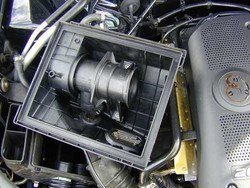
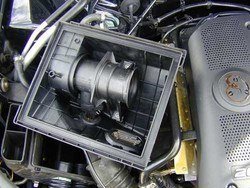
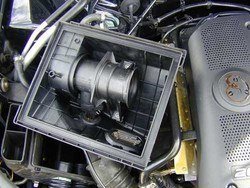
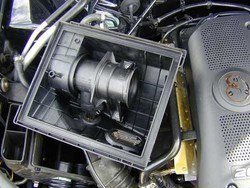
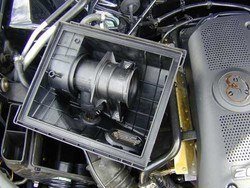
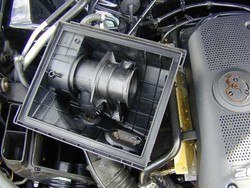
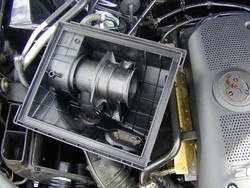
I.E. MAF located inside the Air Filter on the stock VW/Audi 1.8T

Technical-MAF_Snorkel_07.jpg

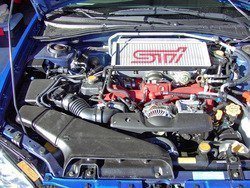
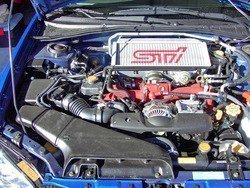
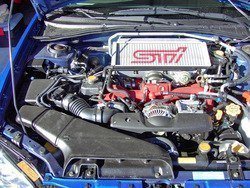
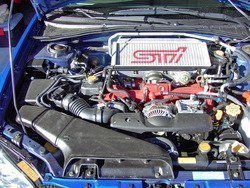
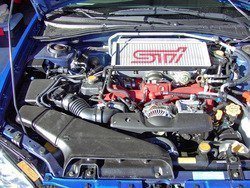
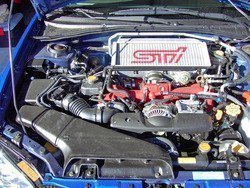
MAF Located just after the Air Filter on the 2.5T STI motor

2006_sti_kn_short_ram_intake1.jpg
 

Attachments

  • Technical-MAF_Snorkel_07.jpg
    Technical-MAF_Snorkel_07.jpg
    50.8 KB · Views: 16
  • Technical-MAF_Snorkel_07.jpg
    Technical-MAF_Snorkel_07.jpg
    50.8 KB · Views: 18
  • 2006_sti_kn_short_ram_intake1.jpg
    2006_sti_kn_short_ram_intake1.jpg
    192.9 KB · Views: 24
  • 2006_sti_kn_short_ram_intake1.jpg
    2006_sti_kn_short_ram_intake1.jpg
    192.9 KB · Views: 25
  • Technical-MAF_Snorkel_07.jpg
    Technical-MAF_Snorkel_07.jpg
    50.8 KB · Views: 15
  • 2006_sti_kn_short_ram_intake1.jpg
    2006_sti_kn_short_ram_intake1.jpg
    192.9 KB · Views: 42
  • Technical-MAF_Snorkel_07.jpg
    Technical-MAF_Snorkel_07.jpg
    50.8 KB · Views: 13
  • Technical-MAF_Snorkel_07.jpg
    Technical-MAF_Snorkel_07.jpg
    50.8 KB · Views: 17
  • 2006_sti_kn_short_ram_intake1.jpg
    2006_sti_kn_short_ram_intake1.jpg
    192.9 KB · Views: 18
  • 2006_sti_kn_short_ram_intake1.jpg
    2006_sti_kn_short_ram_intake1.jpg
    192.9 KB · Views: 17
  • Technical-MAF_Snorkel_07.jpg
    Technical-MAF_Snorkel_07.jpg
    50.8 KB · Views: 14
  • 2006_sti_kn_short_ram_intake1.jpg
    2006_sti_kn_short_ram_intake1.jpg
    192.9 KB · Views: 33
Last edited:
from what I've heard the problem with that though is a few things, blow off valve bleeding off already measured air that fuel will be added for, the density that it is measuring will be different from what the engine will see after boost, & another which is a good reason to just go away from maf all together on our car in particular is that the stock sensor will max out at well below the actual airflow that will be reached even with moderate boost levels, I've heard with the vq at 7psi the maf will max out at ~4krpm, so at that point you are not measuring anything anymore & fuel calculations can become problimatic...

I do agree though that the maf in the pressurized side will def be subjected to turbulence which is also not good for a maf & hard to correct. some will use a screen or a mesh to straighten out the airflow somewhat. I guess this may be the main reason why many factory setups place it at the inlet. I've seen some cars also use a maf right at the throttle body too though...

a factory turbo car is also different because the density changes are factory calculated & the maf will be sized for the total airflow even with the stock turbo setup. I guess there are benefits & drawbacks of each placement, but the fact that you will max out the maf meter alone no matter where it is placed is a problem. there can always be the option of using a larger maf sensor too & recalibrating for it to retain the stock ecu...

a lot of factory cars use both maf & map to better calculate fuel
 
Furthermore proven by the fact that most (if not all) stock turbocharged cars have the MAF located before the Turbo. There are situations where people have removed their MAF altogether when running a specific software, but having a MAF isn't necessarily a bad thing if you can get the proper tune for it.
I agree with this guy.

bay1.jpg

This recirc valve is routed from the cold pipe (post-intercooler) to the turbo's inlet (post-MAF sensor).

In stock form, this is the same setup that's used, but the cold pipe flange to the recirc valve is a bit farther from the throttle body, and where it sends the air is a bit closer to the turbo's inlet.

As for measuring dense air... if you put the MAF close to the air filter, you're measuring a ton of air flow at a slight vacuum. This is THE SAME AIR that enters the combustion chamber!!! There is no amount of air "added" after the turbo or going through the intercooler, it's the same exact amount of air. What the MAF sees flowing just after the air filter is the same amount of air flowing through the throttle body, exact same. There is a delay, however, because this air passes the MAF, then has to be compressed by the turbo, cooled off through the intercooler, and then ran through more piping to end up at the throttle body, but it's a very, very slight delay... so what the MAF sees is pretty much what the combustion chamber sees.

Also, routing the recirc valve back to the suction side of the turbo AFTER the MAF will not "confuse" the MAF at all. Air will NOT go the wrong direction past the MAF. The inlet to the turbo is always at a vacuum and will suck this excess air right back in. Therefor, the air being recirculated stays within the closed system and has already been accounted for by the MAF sensor.

In summary, I say you take a very, very short route for the recirc by plumbing it on the cold pipe just after it passes underneath the intake piping.

1
 

Attachments

  • bay1.jpg
    bay1.jpg
    151.9 KB · Views: 21
  • bay1.jpg
    bay1.jpg
    151.9 KB · Views: 19
  • bay1.jpg
    bay1.jpg
    151.9 KB · Views: 28
  • bay1.jpg
    bay1.jpg
    151.9 KB · Views: 21
  • bay1.jpg
    bay1.jpg
    151.9 KB · Views: 20
  • bay1.jpg
    bay1.jpg
    151.9 KB · Views: 19
That should work; I did something similar before on my old car and I went from maxing out the stock MAF at 7psi and 4400 rpm to not maxing it out even at 11psi and going to redline. But ideally, going to a MAP would be a better solution. It's just a much more expensive solution since the engine management you need to control it is pricey, back in the day I wanted to go AEM, but no one could figure out how to get it to interface with the car, so I wasn't going to risk it. Although I believe Greddy used to sell a MAP sensor that could be used with their emanage kit. I don't know how well that would work.

Pardon my ignorance because I feel like this has been mentioned, but something in the last few posts made me think of this. Would it not help alleviate the issue of maxing out the MAF?

http://z1auto.com/prodmore.asp?model=350z&cat=intake&prodid=2973
 
opening up the maf sensor does allow more resolution to avoid maxing out the sensor.

when it comes to the difference between draw threw & blow threw maf sensing, there really is no right or wrong, each has benefits & drawbacks & both are accepted & sucessful ways to do it...

from the research I've done & the people I've talked to, the general concensus seems to be that blow through can be harder to tune, but better end results in more precise fuel delivery, where draw through is easier to tune but won't be as precise in metering fuel at all times... I got the impression that many would say blow through is the better alternative if your maf supports it, but ultimately the best solution is usually to just go to speed density if you have that option. there is no right or wrong, each method has it's own set of benefits & drawbacks with speed density being the least evil in the potential drawbacks...

---------- Post added at 04:22 PM ---------- Previous post was at 03:57 PM ----------

I As for measuring dense air... if you put the MAF close to the air filter, you're measuring a ton of air flow at a slight vacuum. This is THE SAME AIR that enters the combustion chamber!!! There is no amount of air "added" after the turbo or going through the intercooler, it's the same exact amount of air. What the MAF sees flowing just after the air filter is the same amount of air flowing through the throttle body, exact same.


ok, please don't look at this as me arguing or saying your wrong, were just pooling & sharing info here & hopefully all learning from the exchange, but it is not the exact same... tuning is based on VE (volumetric efficency) when it comes to metering fuel, which is the whole reason for measuring the air in the first place & when air is compressed & heated the volume of O2 per cc in the air changes, it's density changes, so 500cc's of air at 145deg will not contain the same amount of O2 as 500cc's of air at 69deg. the fuel has to match the O2 content of the air entering the engine... this is why the oem's love maf over speed density, because it's measuring the mass air, including the density of the air... a draw through design kinda defeats that to a certain extent where a blow through does not, it's actually measuring the density of the air entering the TB not the air entering the turbo...
 
Last edited:
^I think most people read the first three words of complicated posts and move on. FWIW, I enjoy the technical discussion...

It seems to me that the MAF-before-turbo approach is intended to adjust for ambient air temperature because the factory ECU is already tuned for specific turbo system, whereas the MAF-after-turbo approach is adjusting for differences anywhere in the whole system, from ambient air temp differences to IC efficiency differences to turbo size differences. If that is true, manufacturers would prefer the former due to its ease of use, and tuners would prefer the latter for it's flexibility and accuracy.
 
ok, please don't look at this as me arguing or saying your wrong, were just pooling & sharing info here & hopefully all learning from the exchange, but it is not the exact same... tuning is based on VE (volumetric efficency) when it comes to metering fuel, which is the whole reason for measuring the air in the first place & when air is compressed & heated the volume of O2 per cc in the air changes, it's density changes, so 500cc's of air at 145deg will not contain the same amount of O2 as 500cc's of air at 69deg. the fuel has to match the O2 content of the air entering the engine... this is why the oem's love maf over speed density, because it's measuring the mass air, including the density of the air... a draw through design kinda defeats that to a certain extent where a blow through does not, it's actually measuring the density of the air entering the TB not the air entering the turbo...
Yeah I get where you're coming from, but are you going to be reading 500cc's of air at 69 degrees in the old location where he put the MAF and 500cc's of air at 145 degrees in the new location where I put the MAF?

Generally speaking, tubing going to the inlet of the turbo is a bigger diameter than the cold pipe going from the intercooler to the throttle body... I guess that's where I was making those assumptions of the exact same *amount* of air.
 
the amount of "air" is not what's in question, the density of the "air" is, because the density is what detemines how much actual O2 is in the same exact amount of "air", & this is what changes a lot when air is compressed & heated. a motor at a given point, say 90% VE taking in less dense air will see less actual O2 in the combustion chamber than the same motor at the same 90% VE taking in more dense air.

sorry, I know we can sometimes get very technical, but forced induction is a pretty technically intense thing too, & the technical stuff is really where the difference is between a good setup & a great setup.

I think chucks summary is pretty spot on from the way I gather it too, each "custom" turbo install will be a bit different & blow thru accounts for these differences where draw thru doesn't. factory setups are all identical so draw thru can be used more uniformly across all the same vehicles from an OEM point of view
 
Back
Top