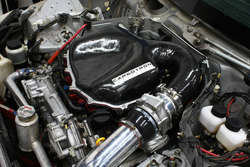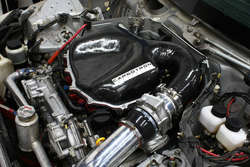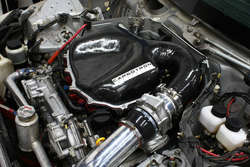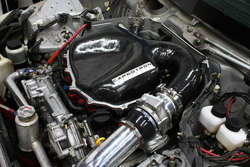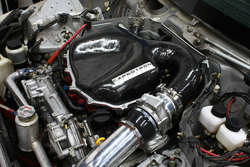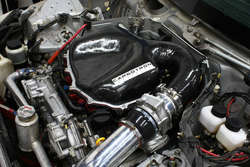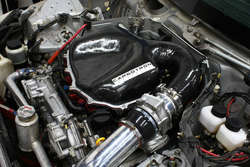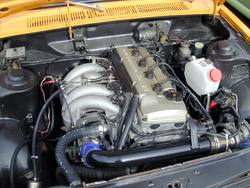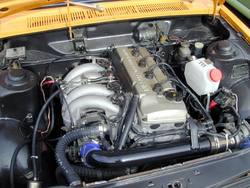
tchuck's custom intake

Update:
So, I've progressed into differential calculus in my quest for the perfect intake. :nerd: I fully remember how little I enjoyed fluid dynamics the first time around. Ironic that I would need to use it for something seemingly as simple as designing an air intake system. Apparently most aftermarket intakes have very little engineering involved in their design due to the complexity of the issue. That's not to say that aftermarket intakes don't work. Trial and error is a very effective tool especially if you have a flow bench and a dyno machine handy. Regardless, here are some of the highlights from my research thus far and some ideas I'm tossing around.

Research & calculations: (I'll try to spare you the formulas and jargon.)
1. The VQ35DE displaces 213.58cu in.
2. At 7000rpms, assuming 100% Volumetric efficiency (usually not the case) it is capable of consuming 432.36CFM.
3. The K&N cone filter that comes with the Stillen CAI is not sufficient to support this flow rate without restricting flow when it's perfectly clean and oiled, let alone when it's old and dirty.
4. The K&N drop in filter does not even meet the minimum flow requirements for 7K rpms at 85% Ve, which is a much more realistic operating efficiency for a stock FX engine at redline. Again, assuming it's brand new and perfectly oiled.
4. Volumetric efficiency (Ve) can in fact exceed 100% and often does in high performance NA motors due to the momentum of the air in the intake tract which pressurizes the combustion chamber. Ve almost always exceeds 100% in FI applications.
5. Cylinder head design is a black art that involves voodoo and chicken bones.
6. Plug your ears Dave; both laminar and turbulent flow exists in the intake tract, and in way more places than I can address. Luckily, the effects of these are minimal enough that I'm going to disregard.

Some ideas: (I've broken this project into three parts; Before the filter, the airbox, and after the filter. Right now I'm working on the portion I call "after the filter" which is between the lower plenum and the airbox.)
1. Increasing the internal diameter and/or reducing the length of the "z-tube". The former would require a revised 3.5" MAF sensor tube, the fairly extensive modification of the velocity stack, and the procurement of a new (larger or possibly odd shaped) filter. The latter would only require a new mounting bracket and possibly a new cylindrical filter that is longer and smaller in diameter than my current cone filter.
2. Incrementally staggering the internal diameter of the intake tube. This one requires a LONG explanation that I'm not up to right now.
3. Modifying the upper plenum from its current "back and to the right" inlet to a more logical and symmetrical "front and center" inlet configuration. This would facilitate a very short and simple intake tract that utilizes the existing air inlets above the radiator. In this case I would have to model a new upper plenum and have it built somewhere. I would also have to relocate the throttle body and everything to which it is attached. A slight bonus is that the MAF sensor wires will still reach. :laugh:

Random question: Does anyone know how much clearance exists between the top of the stock plenum and the bottom of the closed hood? Preferably at the front of the plenum?

I have more but I need to go make dinner. I'll post another update soon.
 
once you start playing with the intake manifold itself that starts to get very tricky. making your own manifold for a drag car that is only concerned about wot & peak power is one thing, but to get the velocities right for throughout the usable power band is extremely critical & will probably take more effort than your ever going to put into it. this is one of those areas where it is very easy to degrade but very difficult to improve. if your serious about improving the manifold itself beyond just a spacer to improve airflow to the front cylinders then you should look at better manifolds. stuff like the cosworth or maybe even the thought of switching to an hr manifold with dual tb's, which is doable & a whole lot easier than building your own manifold if that's what your thinking.

most look at airflow at the intake as air into the motor, which of course it is, but to really understand the intake tract as a whole & see how little things make a big difference you have to realize that the best way to really see the intake tract is from the intake valves point of view. this is what really matters. all of the air in the intake before the throttle body is under vacuum at idle & cruise. the cylinders are trying there hardest to suck in air on there intake strokes from six little holes but the throttle body is stopping the air from going in. it is just letting enough air slip by to keep the engine running but restricting most of what the cylinders are trying to suck in, the cylinders really are always trying hard to suck suck suck. when you nail the throttle, the valves only have available to it instantaneously air that is at maybe 20"hg less pressure than atmospheric, so initially it does not get as much o2 as it ultimately could, but then air that is much closer to atmospheric pressure is also forced in past the TB by this pressure difference & this air too becomes less than atmospheric pressure too until eventually the air supply becomes enough to feed air to the cylinders that is close to atmospheric pressure, this air is more dense & contains more o2 per cfm than the air that is at less than atmospheric pressure. then you let off the throttle & the whole cycle starts over again.

all airflow through the whole intake is based on velocity & allowing the air to move as rapidly as it can into each of the 6 little holes that are ultimately trying to suck all of this air. the whole intake is designed to be like a funnel & a distribution block with rapid traffic flow in mind but also not too much volume, too much volume would take much longer to reach atmospheric pressure when allowed to & this would make for sluggish & doggy throttle response. also anything that upsets the velocity is a hindrance & even distribution & each valve having the same potential is extremely important. there is a lot of science in an intake & building or modifying one can take a lot of trial & error & again, be very difficult to improve on even a mediocre intake like the DE intake manifold.

if your going to keep the mass airflow meter then it is going to be best to maintain the same size tubing from the maf to the throttle body as what's already there to just maintain the velocity. if your going to run speed density then there can def be advantages to having the intake progressively funnel down to the TB, but not if your keeping the maf sensor, & won't see any big benefits with NA really I think. I would just concentrate on feeding the face of the maf sensor inlet with the coolest densest & unrestricted air you can consistently supply it & leave from the TB & further downstream alone unless you really want to replace the whole intake manifold.

btw, this is what makes the 37 hr motor so much more advanced than the 35 hr, it's not the small difference of cylinder volume, it's the fact that on the 37 hr motor there is no conventional throttle body at all. the throttle of the motor is directly controlled by the lift of the valve itself, so at idle instead of a valve fully opening & trying desperately to suck from a vacuum void chamber of the intake manifold it instead only cracks the valve slightly, restricting the intake of the cylinder at the valve itself. why this is so great is that this means that all of the air in the manifold itself is no longer sitting at 20" of vacuum, it is now much closer to atmospheric pressure. this means that when you punch the throttle there the valves have available to it immediately a nice supply of dense air at much higher pressure than a TB car could ever have initially... the throttle response on them is crazy. modifying the manifold itself & you could easily make it into a slugish dog. if you could turn the whole intake around & have the back face foward then remove the 120deg bend that would be good, but short of that can't see so much that can be done with the manifold itself really other than changing it for something else.
 
I'm sure it's not a bolt on affair, but I'm also sure that it won't be too hard to do either... biggest problem will be mass airflow meter, de ecu will not be able to look at 2 & sum the data, so it would have to be run speed density unless you had the 2 tracts combine upstream for one maf sensor, but then you come back to the problem of keeping the velocity up & moving the restriction from the manifold itself to the intake tract anyway & the one maf sensor would be the restriction at that point & cancel many of the gains otherwise acheived with the better manifold in the first place.

it is possible to recalibrate everything for a larger maf sensor too, but may be best to just run it speed density with 2 intakes at that point & eliminate the maf all togeather, may be a little hard to justify all that for a bone stock NA motor though...
 
far as the hr manifold on the de, the de lower manifold uses square ports while the hr uses round but there pretty much same layout & distribution pattern... someone in germany I think has already built an adapter to adapt the hr upper to the de lower & running it on a 350z racecar... it's been done & is doable for sure, but for all that's involved it'll probably be easier & cheaper to just buy a cosworth de intake & call it a day...


here is a picture of a de with an adapter to bolt an hr manifold on:

1


here is the 2 manifolds side by side

1


& here is a DE 350z running an hr manifold in a racecar, running speed desity of course instead of mass air

1


the HR manifold is way way superior to the de manifold, internally it's a very symetrical folded over tuned port type setup, so in some racing classes where stock engine components are required the HR's are being looked at hard to make improvements even while otherwise keeping a de engine. the de manifold is really a pretty crappy design because of all the fitment limitations of the first 350z, opening up both sides though with dual tb's is a world of difference in flow, & evenly distributed flow...
 
Last edited:
once you start playing with the intake manifold itself that starts to get very tricky...

I am only planning to play with the upper plenum. I like the HR manifold idea, it definitely appears to me a much better design. At least it's symmetrical... Why though on both the DE and HR motors, does the intake enter at the back of the plenum? Not to mention the fact that the immediate bend creates an asymmetrical flow situation inside the plenum. That seems illogical to me and I've certainly never seen it on a real race car. That pic on your "on my mind..." thread of the grand national is more in line with what I'm thinking. Inlet @front and center.
Modeling an upper plenum in Solidworks and having a shop build one from aluminum doesn't seem like that big a deal. Solidworks has FEA, thermodynamics plug ins, and even fluid analysis capabilities (Flowworks). It would be way more simple than the cast OEM piece but I could match the internal volume, have it draw from the front, and make it symmetrical, which seems like a fairly significant improvement.

most look at airflow at the intake as air into the motor, which of course it is, but to really understand the intake tract as a whole & see how little things make a big difference you have to realize that the best way to really see the intake tract is from the intake valves point of view...

See my comment above about cylinder head design and chicken bones. :smile: I'm not touching anything below the upper plenum just for that reason. Part of the intake system that requires differential calculus (and more) is to determine the amount of vacuum imparted on the plenum by the pistons at any given time. Basically figuring out at what point decreasing the diameter of (or lengthening) the intake tube stops increasing air velocity and starts restricting flow. Assuming an infinitely powerful vacuum source, this wouldn't happen until the tube rips itself apart. In real life with a VQ35DE, its in the neighborhood of 3.5" in diameter and 15" in length. Another exceedingly complex mathematical issue is deducing the effects of bends in the intake pipe in regard to flow. That's another benefit of the "front and center" plenum approach; To make the intake tract almost perfectly straight from the plenum inlet to the opening above the radiator.
all airflow through the whole intake is based on velocity & allowing the air to move as rapidly as it can into each of the 6 little holes that are ultimately trying to suck all of this air. the whole intake is designed to be like a funnel & a distribution block with rapid traffic flow in mind but also not too much volume, too much volume would take much longer to reach atmospheric pressure when allowed to & this would make for sluggish & doggy throttle response. also anything that upsets the velocity is a hindrance & even distribution & each valve having the same potential is extremely important. there is a lot of science in an intake & building or modifying one can take a lot of trial & error & again, be very difficult to improve on even a mediocre intake like the DE intake manifold.

Here's the kicker: You guys might hate me for this but I would actually wouldn't mind losing a bit of throttle response and trading low end torque for top end HP. Before you pass out here are my reasons for doing so. Between myself, my wife, both of our families, and hopefully soon a little tchuck on the way, I am the only car enthusiast (so far :wink:). I'm the only one who likes the flowmaster, I'm the only one who enjoys a nice soothing WOT run on a deserted road. Unfortunately I'm not the only one who drives the FX. To be honest the existing low end torque and throttle response have a bit of a "neck snapping" quality that I could do without. I'm not anticipating the trade off to be all that significant, but this portion of my modifications are geared that way intentionally. I want it to behave more like a crotch rocket than a muscle car.

if your going to keep the mass airflow meter then it is going to be best to maintain the same size tubing from the maf to the throttle body as what's already there to just maintain the velocity.

Why do I need to maintain velocity @ the sensor? I guess I can maintain the air velocity after increasing the diameter by adjusting the length and adding a bend or two in the tract, which I'm going to have to do anyway in order to get the air inlet to the outside world. Assuming no upper plenum mods of course...

If your going to run speed density then there can def be advantages to having the intake progressively funnel down to the TB, but not if your keeping the maf sensor, & won't see any big benefits with NA really I think.

What do you mean by "run speed density"? I'm unfamiliar with that term. Also, I do plan on keeping the FX NA, but this will not be the end of my mods so I'd like anything I do now to be as forward compatible as possible.
The staggering of the intake tube is probably the most far fetched idea so far and in all honesty it most likely will not happen. The purpose would be similar to how an expansion chamber exhaust pipe works on a two stroke motor. Probably wouldn't even work...
I would just concentrate on feeding the face of the maf sensor inlet with the coolest densest & unrestricted air you can consistently supply it & leave from the TB & further downstream alone unless you really want to replace the whole intake manifold.

I haven't really researched the maf sensor yet. Do you know how exactly it functions in relation to the ECU? Does it take airspeed readings? How does it account for the air heating up (and becoming less dense) between the sensor and the intake port?

... if you could turn the whole intake around & have the back face foward then remove the 120deg bend that would be good, but short of that can't see so much that can be done with the manifold itself really other than changing it for something else.

That upper plenum idea is exactly what I'm thinking, but it certainly wont fit if you just spin it 180deg...will it? That is where my idea for modeling a new upper plenum with a "front and center" inlet originated.

Thanks for the reply turbo! This is great info. :tup:

---------- Post added at 11:24 AM ---------- Previous post was at 11:20 AM ----------

far as the hr manifold on the de, the de lower manifold uses square ports while the hr uses round but there pretty much same layout & distribution pattern... someone in germany I think has already built an adapter to adapt the hr upper to the de lower & running it on a 350z racecar... it's been done & is doable for sure, but for all that's involved it'll probably be easier & cheaper to just buy a cosworth de intake & call it a day...


here is a picture of a de with an adapter to bolt an hr manifold on:

1


here is the 2 manifolds side by side

1


& here is a DE 350z running an hr manifold in a racecar, running speed desity of course instead of mass air

1


the HR manifold is way way superior to the de manifold, internally it's a very symetrical folded over tuned port type setup, so in some racing classes where stock engine components are required the HR's are being looked at hard to make improvements even while otherwise keeping a de engine. the de manifold is really a pretty crappy design because of all the fitment limitations of the first 350z, opening up both sides though with dual tb's is a world of difference in flow, & evenly distributed flow...

I'm liking this idea more and more...
 
Last edited:
speed density is when the ecu uses a map sensor(reads & calculates engine load based on maniold pressure) rather than a maf sensor. it is a way to eliminate the maf sensor all togeather, but requires at least a piggyback ecu, not acheivable with just reflashing the stock ecu alone.

the maf sensor system measures actual air temp, it also heats a wire & measures how much energy it takes to maintain the wire temp vs how much it is being cooled by the air passing over it. this is how it calculates the actual mass air flow. a map sensor does none of this, it just measures engine load by reporting actual manifold pressure. either is enough for an ecu to calculate fuel tables & amount of fuel needed, but technically maf is more acurate & precise because it is not assuming, it is actually measuring... from a power point of view map is better in many ways, maf is better to keep the emmisions as low as possible on the oe level...


"Modeling an upper plenum in Solidworks and having a shop build one from aluminum doesn't seem like that big a deal. Solidworks has FEA, thermodynamics plug ins, and even fluid analysis capabilities (Flowworks). It would be way more simple than the cast OEM piece but I could match the internal volume, have it draw from the front, and make it symmetrical, which seems like a fairly significant improvement."

well with this approach then my cautions advised are much less applicable. if you have these abilities & support then you are already leaps & bounds ahead of just a shade tree mechanics approach which is what I intially feared you had in mind. I didn't think you would go to the extent necissary but from what your talking about now I guess I underestimated your abilities & knowledge there... I'm impressed
 
speed density is when the ecu uses a map sensor(reads & calculates engine load based on manifold pressure) rather than a maf sensor. it is a way to eliminate the maf sensor all together, but requires at least a piggyback ecu, not achievable with just reflashing the stock ecu alone.

the maf sensor system measures actual air temp, it also heats a wire & measures how much energy it takes to maintain the wire temp vs how much it is being cooled by the air passing over it. this is how it calculates the actual mass air flow. a map sensor does none of this, it just measures engine load by reporting actual manifold pressure. either is enough for an ecu to calculate fuel tables & amount of fuel needed, but technically maf is more acurate & precise because it is not assuming, it is actually measuring... from a power point of view map is better in many ways, maf is better to keep the emmisions as low as possible on the oe level...


"Modeling an upper plenum in Solidworks and having a shop build one from aluminum doesn't seem like that big a deal. Solidworks has FEA, thermodynamics plug ins, and even fluid analysis capabilities (Flowworks). It would be way more simple than the cast OEM piece but I could match the internal volume, have it draw from the front, and make it symmetrical, which seems like a fairly significant improvement."

well with this approach then my cautions advised are much less applicable. if you have these abilities & support then you are already leaps & bounds ahead of just a shade tree mechanics approach which is what I initially feared you had in mind. I didn't think you would go to the extent necessary but from what your talking about now I guess I underestimated your abilities & knowledge there... I'm impressed

I'm no Rookie, but I'm no rookie. :wink:

---------- Post added at 11:12 PM ---------- Previous post was at 12:34 PM ----------

Check this out: Almost exactly what I'm thinking but still backwards for some reason. That and I definitely wont be able to make mine from cf. I can't understand why everyone runs the inlet out the back. It's either to clear the hood and strut bar on a Z or I'm missing something...
From my350z.com:
pic01.jpg

Here's a video with a dyno run. It also shows the effect of an "infinitely unrestricted" plenum. Granted this has a larger TB as well but the idea is the same.

SG-Motorsport VQ35 Intake Testing on Vimeo

and here's the thread:
http://my350z.com/forum/na-builds/4...ke-plenum-ls2-90mm-tb-dynos-video-pics-7.html
 

Attachments

  • pic01.jpg
    pic01.jpg
    104.7 KB · Views: 71
  • pic01.jpg
    pic01.jpg
    104.7 KB · Views: 54
  • pic01.jpg
    pic01.jpg
    104.7 KB · Views: 76
  • pic01.jpg
    pic01.jpg
    104.7 KB · Views: 48
  • pic01.jpg
    pic01.jpg
    104.7 KB · Views: 52
  • pic01.jpg
    pic01.jpg
    104.7 KB · Views: 60
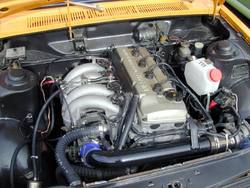
The guy who did my KA24DE 510 swap chose a poor route for the MAF and tube... above the radiator! It actually runs quite well, considering, but I could be getting much more from this setup. A friend of mine is running turbo and NOS on his KA24 dime... scary fast!

Good luck with the design... great reading thread.

KA24DE-510.jpg
 

Attachments

  • KA24DE-510.jpg
    KA24DE-510.jpg
    42.3 KB · Views: 52
  • KA24DE-510.jpg
    KA24DE-510.jpg
    42.3 KB · Views: 54
  • KA24DE-510.jpg
    KA24DE-510.jpg
    42.3 KB · Views: 44
  • KA24DE-510.jpg
    KA24DE-510.jpg
    42.3 KB · Views: 67
  • KA24DE-510.jpg
    KA24DE-510.jpg
    42.3 KB · Views: 41
  • KA24DE-510.jpg
    KA24DE-510.jpg
    42.3 KB · Views: 61
Another quick update. This one wasn't on the agenda but it sort of relates to the whole "customized intake" idea. Don't get your hopes up, it's pretty silly but I was bored and already had the plenum on my workbench.
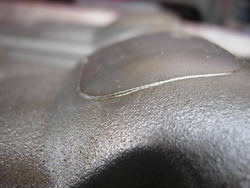
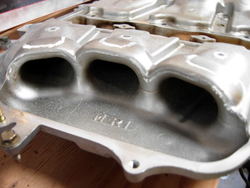
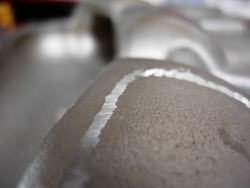
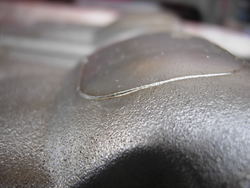
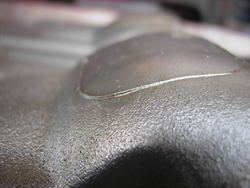
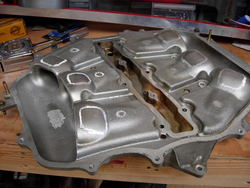
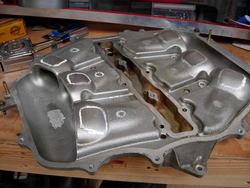
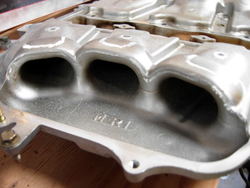
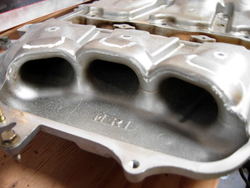
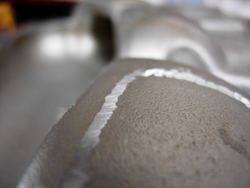
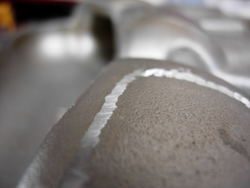
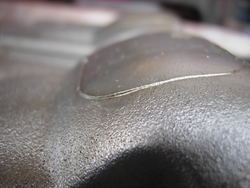
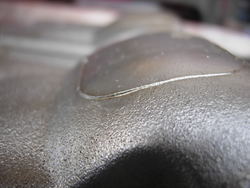
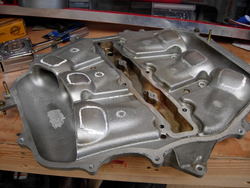
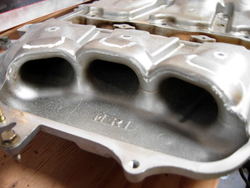
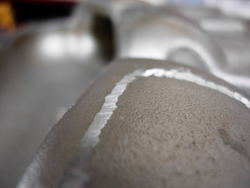
I removed my upper and lower plenum today to get some measurements and to properly clean out the lower plenum. (When I cleaned my TB and upper plenum a few weeks ago I ran out of daylight and time so I couldn't do the lower half.) Anyway, while I was cleaning the lower half I noticed a lot of sharp burs and edges from the casting process, like this:
DSCN1843.jpg

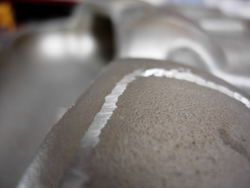
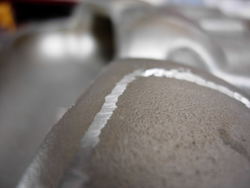
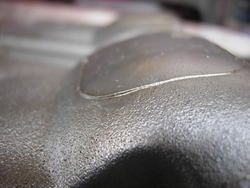
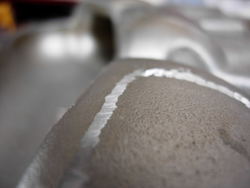
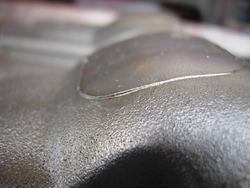
I had some time to kill before my wife got home so I grabbed my Dremel and ground them smooth, like this:
DSCN1844.jpg

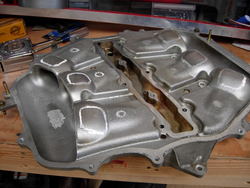
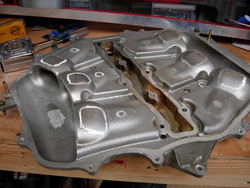
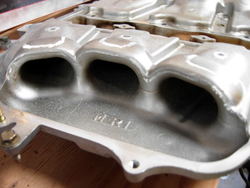
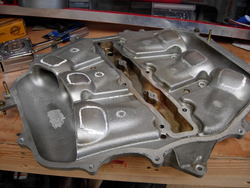
This one shows the locations of the casting relics. The largest of which were on the vertical faces of the intake ports.
DSCN1847.jpg

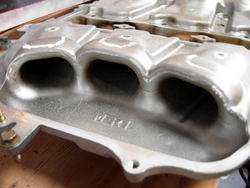
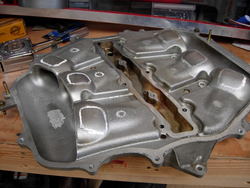
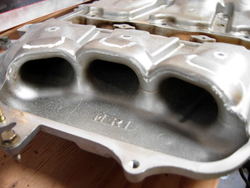
Here's the completed lower plenum. Probably the most time consuming part of this process was cleaning the metal shavings out afterward. It took compressed air, carburetor cleaner, shop towels, more compressed air, and an old toothbrush to be sure they were gone.
DSCN1848.jpg

---------- Post added at 01:54 AM ---------- Previous post was at 12:27 AM ----------

P.S.
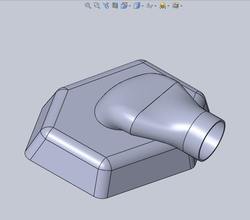
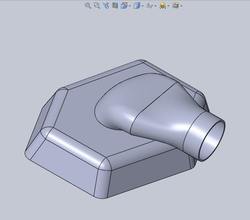
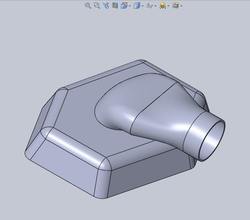
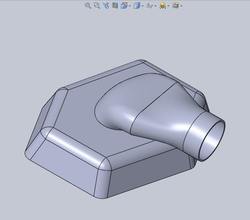
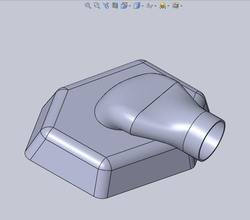
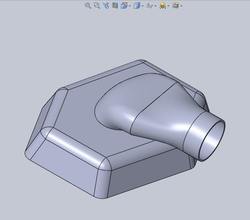
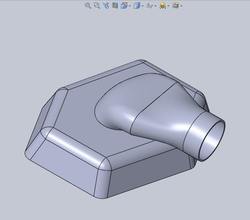
Here's a teaser of my plenum design. This is a VERY preliminary design and at this point incorporates few real dimensions and zero engineering. It is however, a good visual representation of my direction. Not sure yet how it's going to hold up to the flow analysis... :wub: Fortunately I have a lot of work to do between now and then.

plenum1iso2.jpg
 

Attachments

  • DSCN1844.jpg
    DSCN1844.jpg
    64.2 KB · Views: 51
  • DSCN1843.jpg
    DSCN1843.jpg
    93.5 KB · Views: 87
  • plenum1iso2.jpg
    plenum1iso2.jpg
    23.1 KB · Views: 56
  • DSCN1848.jpg
    DSCN1848.jpg
    132.2 KB · Views: 141
  • DSCN1847.jpg
    DSCN1847.jpg
    97.9 KB · Views: 93
  • DSCN1843.jpg
    DSCN1843.jpg
    93.5 KB · Views: 79
  • DSCN1847.jpg
    DSCN1847.jpg
    97.9 KB · Views: 85
  • DSCN1844.jpg
    DSCN1844.jpg
    64.2 KB · Views: 124
  • DSCN1848.jpg
    DSCN1848.jpg
    132.2 KB · Views: 77
  • plenum1iso2.jpg
    plenum1iso2.jpg
    23.1 KB · Views: 39
  • plenum1iso2.jpg
    plenum1iso2.jpg
    23.1 KB · Views: 48
  • DSCN1848.jpg
    DSCN1848.jpg
    132.2 KB · Views: 68
  • DSCN1847.jpg
    DSCN1847.jpg
    97.9 KB · Views: 60
  • DSCN1844.jpg
    DSCN1844.jpg
    64.2 KB · Views: 70
  • DSCN1843.jpg
    DSCN1843.jpg
    93.5 KB · Views: 87
  • DSCN1848.jpg
    DSCN1848.jpg
    132.2 KB · Views: 58
  • DSCN1847.jpg
    DSCN1847.jpg
    97.9 KB · Views: 72
  • DSCN1847.jpg
    DSCN1847.jpg
    97.9 KB · Views: 69
  • DSCN1844.jpg
    DSCN1844.jpg
    64.2 KB · Views: 50
  • DSCN1844.jpg
    DSCN1844.jpg
    64.2 KB · Views: 57
  • DSCN1843.jpg
    DSCN1843.jpg
    93.5 KB · Views: 59
  • DSCN1843.jpg
    DSCN1843.jpg
    93.5 KB · Views: 64
  • DSCN1848.jpg
    DSCN1848.jpg
    132.2 KB · Views: 66
  • plenum1iso2.jpg
    plenum1iso2.jpg
    23.1 KB · Views: 63
  • plenum1iso2.jpg
    plenum1iso2.jpg
    23.1 KB · Views: 48
  • DSCN1843.jpg
    DSCN1843.jpg
    93.5 KB · Views: 63
  • DSCN1844.jpg
    DSCN1844.jpg
    64.2 KB · Views: 89
  • DSCN1847.jpg
    DSCN1847.jpg
    97.9 KB · Views: 62
  • plenum1iso2.jpg
    plenum1iso2.jpg
    23.1 KB · Views: 58
  • DSCN1848.jpg
    DSCN1848.jpg
    132.2 KB · Views: 54
Looks pretty good....how's the clearance with the hood?

Actually that version doesn't fit under the hood.

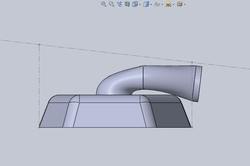
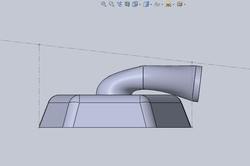
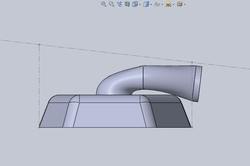
But this one does:

plenum2side1.jpg

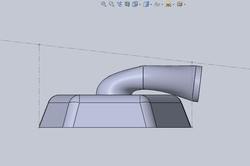
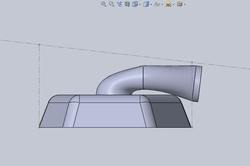
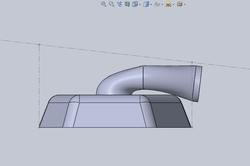
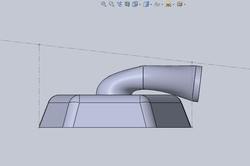
The angled dashed line above the plenum is parallel to, and offset 1/2" from, the underside of the hood @ the middle. If I remove the sound/heat insulation I could get another inch or so. Just depends on the final TB orientation. I'm also going to scoop the middle out so I can lower the intake duct a bit more. That should totally address any clearance issues. This is a long shot but I'm thinking it might even be possible to design in an allowance for a strut bar to pass between the main chamber and the mouth... That's pretty low on the priority list though, honestly.

Anyone know if the throttle body needs to be perfectly horizontal? Off the top of my head, it seems like most of them are installed that way but I can't think of why it would really need to be level.

Anyone have any game changing/deal breaking thoughts or ideas? Constructive criticism?
 

Attachments

  • plenum2side1.jpg
    plenum2side1.jpg
    15.3 KB · Views: 57
  • plenum2side1.jpg
    plenum2side1.jpg
    15.3 KB · Views: 43
  • plenum2side1.jpg
    plenum2side1.jpg
    15.3 KB · Views: 40
  • plenum2side1.jpg
    plenum2side1.jpg
    15.3 KB · Views: 39
  • plenum2side1.jpg
    plenum2side1.jpg
    15.3 KB · Views: 35
  • plenum2side1.jpg
    plenum2side1.jpg
    15.3 KB · Views: 46
why?

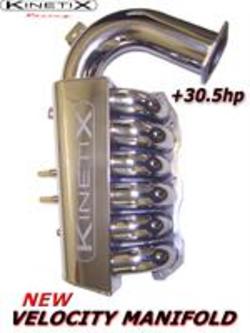
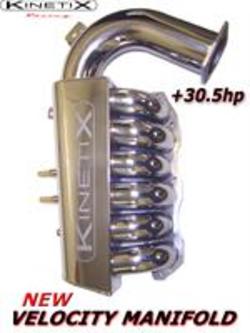
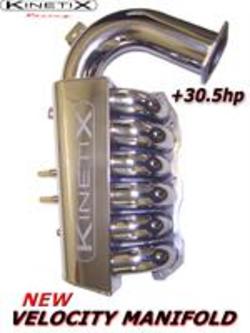
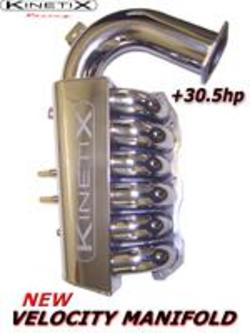
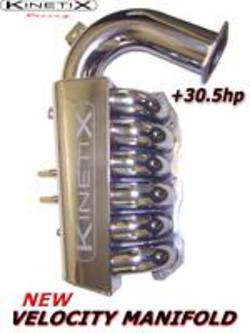
the lower plenum will be your bottleneck. and even if you did open up the lower plenum, it would be too much air, just like installing a Kinetix Racing Velocity Manifold newvelocity350zwithtextcopy.jpg

seems like you are trying to reinvent the wheel... sorry Im not trying to bash.
 

Attachments

  • newvelocity350zwithtextcopy.jpg
    newvelocity350zwithtextcopy.jpg
    7 KB · Views: 38
  • newvelocity350zwithtextcopy.jpg
    newvelocity350zwithtextcopy.jpg
    7 KB · Views: 35
  • newvelocity350zwithtextcopy.jpg
    newvelocity350zwithtextcopy.jpg
    7 KB · Views: 32
  • newvelocity350zwithtextcopy.jpg
    newvelocity350zwithtextcopy.jpg
    7 KB · Views: 37
  • newvelocity350zwithtextcopy.jpg
    newvelocity350zwithtextcopy.jpg
    7 KB · Views: 41
  • newvelocity350zwithtextcopy.jpg
    newvelocity350zwithtextcopy.jpg
    7 KB · Views: 35
there you are adding way more volume to the plenum which is going to hurt bottom end big time, yet not take full advantage of top end either because the whole lower manifold is still longer skinnier runners... it's like putting a tunnel ram on a tiny head motor, not going to work well really, you'd create one hell of a flat spot & kill throttle response. if your going to add so much volume to the plenum then you'd want to open up the runners quite a bit to, but then your tuning more for upper end horsepower while sacrificing you whole torque curve in the midrange. keep in mind that the difference between just a 5/16" spacer to a 3/8" spacer to a 1/2" spacer is noticeable. a 1/2" spacer even sacrifices a bit of torque in the midrange & is considered too much by some for a stock street car even, & that is really not adding a whole lot of volume to the plenum either, but enough to affect the torque curve. I'd say you try to stay around the same plenum volume as the stock manifold if your going to play with this & not alter the lower plenum.

keep in mind that Nissan knows the VE of there engine, & has peak VE in mind across the board as they develop the manifold itself. they have a ton of R&D into it, & peak VE across the board is something they are very aware of. sure they have tuned the manifold for a balance of mid range torque while trying not to sacrifice too much VE at WOT, but you can be pretty sure that the manifold itself is not too restrictive compared to the VE of the engine as it is stock. most times someone is considering upgrading the stock manifold is going to be because they also improved the VE of the engine itself by either FI or at least head/cam work, otherwise the VE of the engine itself is not going to change from what it already is. the manifold on a stock head normally aspirated DE is not such a limiting factor really, the real deficiency is even cylinder feeding which is where they lack a bit, but a spacer alone solves that problem really without negatively affecting the throttle response across the whole band. the 120deg bend on the inlet is a problem when VE is increased, then it becomes a bottleneck.

to really benefit from opening up the manifold the way your thinking then you will need to increase the VE of the engine itself. cams & head work may make something like what your looking at doing be beneficial for peak HP, but you have to also address the runners themselves to really take advantage & you will be shifting the curves up, hurting acceleration & overall drivability unless you also match this with a very loose converter that will allow the engine to jump up higher into it's operating range for acceleration.

what you are proposing there as shown with no head/cam work & no FI will make the fx a sluggish dog all by itself I think & probably bog with a huge flat response as you nail the throttle

the main reason I would think that many TB's are horizontal is to maintain the velocity through the TB, so it would only make sense to try & point it toward the direction of the feed, pointing it up would mean a sharp curve right before it which is probably not such a hot idea, otherwise there is no reason a TB has to be horizontal, it will work even facing straight up, but with the problem of a sharp curve right at the mouth of the TB, not because of it's orientation. there have been many engines with TB's pointing straight up, but unless you have a lot of room to work with it's not an ideal layout, most modern manifolds are folded over designs, like ours is too... if you could straighten the runners all out & have the TB be at the very top we'd have a very tall manifold for sure, folding over or crossing the runners & having the TB sideways makes for a much more compact design that still flows well

---------- Post added at 08:27 PM ---------- Previous post was at 08:20 PM ----------

I hate to say it, but even if you do know a whole lot about fluid dyamics, I don't think that is enough for you to redesign a manifold & not kill everything. I'd recommend that you take a crash course in VE & learn the hows & whys of manifold design to really do anything with the manifold itself. I'm all for DIY, but you need to know exactly what it is your really trying to improve & understand all the trade=offs involved too.
 
man, this thread beats all the textbook readings im supposed to be doing instead of on iS

great comments guys... interesting read, a lot to learn!

tchuck i applaud your motivation
 
there you are adding way more volume to the plenum which is going to hurt bottom end big time, yet not take full advantage of top end either because the whole lower manifold is still longer skinnier runners...
... I'd say you try to stay around the same plenum volume as the stock manifold if your going to play with this & not alter the lower plenum.

I'm going to match the internal volume of mine to the stock plenum with a 3/8" spacer. No plans to alter the lower plenum. My goal with the revision is to make it symmetrical, eliminate the bends, and have it feed from the front. Hopefully this will provide a more equal flow to all the pistons as well.

keep in mind that Nissan knows the VE of there engine...
... the 120deg bend on the inlet is a problem when VE is increased, then it becomes a bottleneck.

I'm not saying Nissan doesn't know what they were doing, but isn't it true that the stock plenum came straight from a 350Z and is slanted to clear the 350's strut bar? The angled plenum spacer helps with this problem, but it far from eliminates the issue entirely. The stock upper plenum feeds from one end (which happens to be the back), and it's the large end. This is the "loophole" I am exploiting. I do not think I am more capable or have better tools than the engineers at Nissan. I just know I have different goals and different restrictions than they did. (more room for one thing) They didn't even attempt to design a plenum specifically for the FX after all, so I'm really not even competing with them.

what you are proposing there as shown with no head/cam work & no FI will make the fx a sluggish dog all by itself I think & probably bog with a huge flat response as you nail the throttle

This iteration is FAR from finalized. It's merely a visual representation of how I plan to feed the plenum symmetrically and from the front. The dimensions and proportions will certainly change.

the main reason I would think that many TB's are horizontal is to maintain the velocity through the TB...
... folding over or crossing the runners & having the TB sideways makes for a much more compact design that still flows well

Nice. The reason mine might be angled (it's only a few degrees anyway) would be to eliminate any sharp bends in the intake tract.

---------- Post added at 08:27 PM ---------- Previous post was at 08:20 PM ----------

I hate to say it, but even if you do know a whole lot about fluid dyamics, I don't think that is enough for you to redesign a manifold & not kill everything. I'd recommend that you take a crash course in VE & learn the hows & whys of manifold design to really do anything with the manifold itself. I'm all for DIY, but you need to know exactly what it is your really trying to improve & understand all the trade=offs involved too.

I'm definitely trying to learn as much as possible right now from anywhere I can find. You have any resource recommendations?

Do you really think an asymmetrical plenum that feeds from the back and is so severely angled that it short changes the front pistons is something I can't improve upon? Look at the intake plenum on any high performance vehicle. Nothing looks even close to the stock VQ35DE plenum and the vast majority are symmetrical and feed from the front. From the VQ35HR to the GT-R, all the way up to the Ferrari California; Symmetry symmetry symmetry. I don't blame you for your lack of confidence, after all we don't know anything about each other. Remember though, that this is simply my free time we're talking about here. I'm not trying to make crazy claims or sell anything to anyone. There isn't even a risk of damaging my own engine if it comes out bad, let alone hurting myself. I'm completely open to the idea that it might not work and I'm ok with that. Personally, I think it will work (especially with the help of such knowledgeable peers as yourself :wink:) and I don't understand why so many people are so against me trying. To each their own I suppose. I definitely appreciate all the input, I just wish it was more constructive and less cautionary. If I come to a point where I think it can't be done, I'll stop, no problem. After all, I still have an air box to design...:laugh:
 
I gotta agree - I think you need to read between the lines with the inputs. Most of them are not constructive because your project is not practical from a value standpoint. If it were, tuner communities would have already done this beyond what we have seen in the Kinetix, APS & Cosworth examples - which by forum consensus have mixed results - certainly nothing worth the $1200 that Cosworth wants.

VQ has been around for a long time and an intake plenum is no simple geometry. You're making a lot of assumptions as to why the plenum was designed a certain way (I certainly don't know why it's designed like that) and thinking a front feed would be "better" based on what - notional theory? The push-back you feel might just be the community saying, "been there, tried that, fell back on what is out there because it's still better than OEM, watching yet another attempt and are hopeful you'll come up with something ground breaking but not holding our breath".

As an engineer, I'd be interested in what tools you would be using to calculate flow. Some sort of finite element analysis would be the way to go - or software specific to engine development applications. If you don't have specialized tools or software and are using artistic intuition with no real objective calculations, I find it difficult to know where to start, "helping". Your concept looks cool but how anybody could improve on it without working with a prototype and a flow bench is where I lose touch with this thread.
 
I always wondered if you could stick a maxima or 3.5 altima manifold in our engines. that would give you a different angle for sure.

the other problems I see relocating the TB is all the cables and wiring that needs to be moved.
 
Back
Top