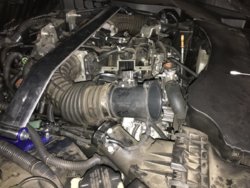
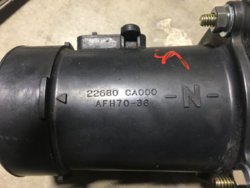
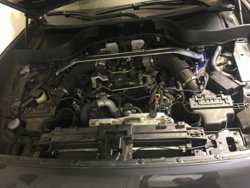
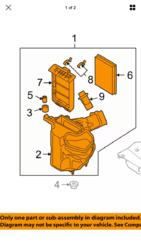
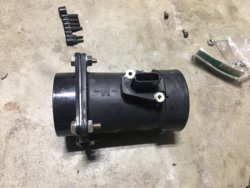
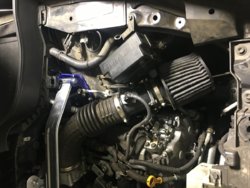
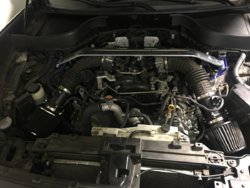
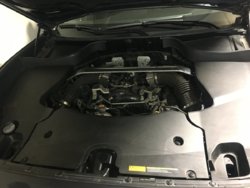
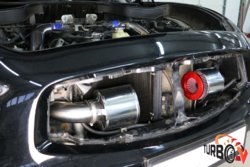
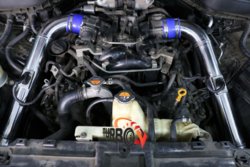
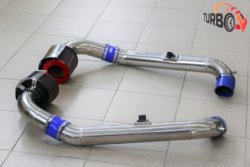
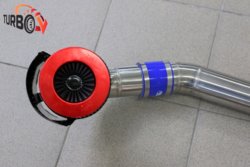
Your english is fine V. I see the heat shield doesn't wrap the filter as much as I thought it did. That's good. With your V8 and dual intake/throttle body set up, more power is available to you. I made 8hp/5tq on my intake, V6 with single throttle body. Not to argue but in no way can the air filters compensate for pipe length or diameter. If you have aftermarket software for your ecu you can go with larger diameter pipes along with a larger diameter MAF housing which makes a big difference. The intakes look great. If you remove the 90* bends as I mentioned above and you don't notice a significant difference, I'll fly to Russia and you can kick me in the nutz

. Big fan of Buteyko and Frolov!
Below is a quote from my thread which is the best I've found regarding this topic. If you dig around my thread (the link below) you'll see where I added length and a 90* bend to get my filter out of the bay and what it did to performance. Killed it. You might not be affected as negatively because you're engine draws air from 2 pipes. You might've gotten a nice bump just because the oem units suck so much ass whereas my negative experience with more pipe and bends was AFTER I tuned for the large diameter short pipe. The difference was night and day.
FX35 - onthemove MOD's
"Here's some down and dirty regarding the effects of intake length and size. Found this while researching "lowest pressure drop designs". A written explanation of why elongating AND introducing a 90* bend in my pipe just to get the filter lower and out of the bay failed so miserably. The power loss was so dramatic I felt it right away and there was no doubt in my mind I fucked up.
Easy Performance | CAI System Design Consideration Primer
" What this means is going from a 4 inch duct to a 3 inch ID duct increases the friction losses by ~2.7 times. Thus, it is not hard to see that a 4 inch duct is preferable over a 3 inch duct by reducing friction losses as well as lowering the air velocity by nearly half. "
" If a 90° bend is designed into the intake duct, then the following can be estimated as shown in the following table. In these examples, 3" and 4 " ID pipes are given. For these pipe sizes, the centerline radius of close 90° elbows are typically equivalent to the diameter of the pipe.

These calculations illustrate the addition of a single 90° bend in a 3-inch or 4-inch duct is the same as adding 48 inches or 64 inches of straight duct respectively in its place. When compared to the rather short length desired for the intake duct, adding a single bend has a dramatic affect on increasing the intake's resistance to airflow. For bends other than 90°, they can be estimated by multiplying the 90° bend resistance by a percentage factor. For a 45° bend, the total friction loss is about 65% of the 90° bend's resistance. For a 180° bend, the total friction loss is about 140% of the 90° bend's resistance.
From the above table, one might conclude that the 48 inch equivalent length given by a 3 inch ID pipe would provide less friction than the 64 inch equivalent length for a 4 inch ID pipe. However, one must now determine the friction that is produced by these two pipe sizes before making such a judgment. As shown earlier, the 3 inch pipe has 2.69 times more friction than a 4 inch pipe. If you calculate the equivalent length of 4 inch ID pipe that would have the same friction as the 90° bend in a 3 inch ID pipe, then you would need to multiply the 48 inch equivalent length by 2.69. This result tells us the 90° bend in a 3 inch pipe is equivalent to 119 inches of 4 inch ID straight pipe. Thus, having bends and smaller pipe diameter is detrimental towards producing good flow characteristics in an induction system."
" Materials that have high reflectivity coefficients are primarily metals and of those, copper, silver, gold and aluminum are among the highest. All of these metals have reflectivity coefficients above 0.96. This means they reflect more than 96% of all the thermal radiation that strikes their surface. For the construction of induction systems, aluminum tends to be a good material of choice. Plastics and other organic materials tend to be very poor at reflecting radiant heat. The reflectivity coefficients of plastics and rubbers tend to be below 0.06. This means plastics only reflect less than 6% of all the thermal radiation that strikes their surface. This means over 94% of the radiant heat is absorbed by the plastics or rubbers. Consequently, they are undesirable materials when exposed to radiant heat. "
" Summation
When considering how to design an optimal induction system for a particular vehicle, all of the design aspects discussed earlier as well as other characteristics must be given careful consideration. Restricting the design considerations to the aspects discussed above, some basic design conclusions can be listed.
- Select a high flow surface impingement style filter element
- Use as large a filter element as practical for the application
- Position the filter so the least amount of dirt and debris will be entering the filter
- Maintenance the filter regularly to maintain optimal performance
- Use as large of an intake duct as practical to connect the filter element to the engine
- Intake duct's interior surface should be as smooth as possible
- Avoid rapid changes in diameters/cross-sectional areas through the induction system
- Avoid or limit the bends needed in the induction system
- Keep the intake track to the engine as short as possible
- The induction system should draw 100% of its air from outside the engine bay or where minimally higher than ambient air temperature regions exist
- All induction component surfaces that are exposed to higher temperature components and surfaces should be made of highly thermal reflective materials
- All surfaces that come in contact with the intake air should be insulated from all potential heat sources "