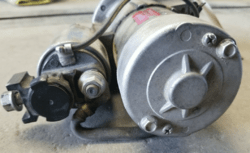
Hi! Thanks for your responses. Very helpful.
This sounds like a starter issue. One of four things are happening. Ranked most likely to least likely.
1. The magnetic switch on the starter may be faulty where the contacts inside are worn out.
2. The brushes inside the starter are worn out and are barely touching the armature (the starter motor).
3. The starter is motor is stopping in a spot where it's not positioned to electrically take on power to turn.
4. When the dealer replaced the ignition harness, it's possible the harness on the starter (one harness connection and one think positive battery terminal) were not secured correctly.
Above points explained:
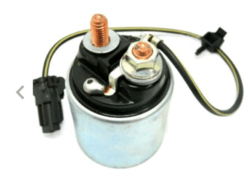
1. The magnetic switch may be faulty where the contacts inside are worn out from usage. It's basically a magnetic relay that transfers power directly from the battery to the starter motor. From repeated usage the copper contacts inside erode and eventually become uneven enough or worn out beyond tolerances. 51000 miles is not a whole lot where this should fail but that also depends on how often the car is being started. But sometimes parts do tend to fail sooner and there's no rhyme or reason. (See below image showing the part itself. Part No: 23343-EY00B).
When you put the booster on the battery the added amperage is driving the magnetic switch harder which is making the contacts work. Now because this happens on and off is likely due to the contacts inside the magnetic switch eroding differently every time the car is started but ideally the magnetic switch needs to be replaced. Temperature has it's own effect on components where things expand and shrink and is enough to make something work intermittently when it's nearing it's end of life.
I replaced the magnetic switch on my starter around 110k miles while it was still working to avoid being stranded somewhere inconvenient. Removing the starter is a bit of a pain on the AWD because of the front axle being in the way but it is possible. While I was replacing magnetic switch I also checked the brushes and they were about 70% of their lifespan which was good enough so I did not replace them. The one thing about the brushes is that there's a total of four. One set of brushes are easily replaceable (which I would have to say is due to them being the ones that get the positive voltage hit from the battery and wear out faster) while the other set will need someone to remove the old ones from the brush holder and crimp the wire and solder it in.
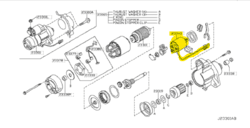
The actual magnetic switch. It's a sealed design so there's no way to see the contacts. But there's ways to test it which I will explain below:
 2.
2. The brushes on the starter are worn out enough where they barely contact the armature but may work intermittently. Temperature changes can affect this part as well.
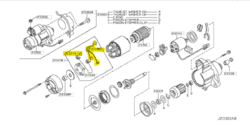 3.
3. The starter motor is positioned in a spot where the brushes are sitting in between pads on a commutator. This is a long shot but I've seen this in some cars before. Haven't seen it on an Infiniti so I assume the starter was designed well enough to avoid such issue. Usually what guys would do it while one person is turning the key (pressing the start button) the other is tapping the starter with a hammer. This would be enough to move the starter motor (armature) enough to allow the brushes to land on the commutator correctly. This is a good way for diagnostic purposes but not something I'd recommend anyone doing on a daily basis.
4. It's possible that when the ignition harness was being replaced the dealer may have touched the starter wires. There's two wires that go into the starter. The first wire is a single thin wire harness that connects into the magnetic switch. This cable carries 12v +ve power when the start button is pressed to power the magnetic switch which then transfers power from the second larger cable carrying +ve power from the battery through the magnetic switch to the starter motor (armature). If any of these are loose they can cause issues but I'm going to say the technician did this correctly though I have my doubts since this issue came about when you had the ignition harness replaced.
With all that being said, I'm pretty sure we have the answer but there's just a few more diagnostics to go through to nail this 100% I'd hate having to see someone spend $$$ where it's not required but it could very well be exactly the part that needs replacing.
This is something you can do yourself or if preferred, the dealership can do but I have my reservations as I've seen enough laziness and incompetence. If the dealership is willing to do what's required then you'll be able to get this over with as I can see this being very annoying having to boost the car this often.
Ideally what I would do is a follows. This is in an order that eliminates as much unnecessary work as possible while maintaining as much of all the possible conditions that could be present with how the car is. The car would have to be in a state where the issue presents itself most of the time.
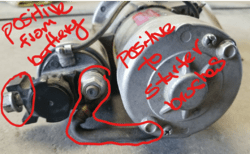
1. Inspect the starter and see if the magnetic switch harness is clipped in correctly and that the battery positive terminal cable is attached to the magnetic switch. If you use any tools, I'd disconnect the battery first to prevent any short circuits. The positive from the battery carries a lot of amperage and if you short circuit this to the car you could end up with a dead battery, injury, not fun. Disconnect battery first if any of these are loose.
Just in case my writing is hard to read, this is what I wrote:
Left hand: "Positive from battery"
Right hand: "Positive to starter brushes"
That thin black cable on the magnetic switch is the positive trigger that feeds 12volts to the magnetic switch when you press the start button.
2. I would test the starter's magnetic switch while it is installed on the car. You can do this in a few ways. While you can use a multimeter (digital/analog), I prefer to use a 12 volt bulb. It's easy to see something light up versus digits briefly flash on a multi meter. Especially when you're alone testing and there isn't a second person pressing the start button. Now I would attach the bulb to the positive starter brush cable. That's where the power goes when the magnetic switch energizes. That way you can see if power is actually going to the starter motor. This is where you test if the magnetic switch is the problem. If the starter (magnetic switch clicks) but the bulb does not light up and the starter does not turn, then its definitely the magnetic switch. Now if the bulb lights but the starter motor doesn't spin, then the brushes or position of the motor (armature) are the problem. If the car starts fine, then see if you can create the scenario where it does not start and use this method to test the magnetic switch.
3. Now if you're able to get the bulb not to light up when the starter clicks you'll want to pull the starter and inspect it. I would only open up the back of the motor to check the brushes and pull the magnetic switch off. If the brushes look healthy with plenty of life left and the commutator on the armature is still good, then just replace the magnetic switch. The magnetic switch contains a few parts like a metal spring and what appears to be a plastic lever that engages the starter "bendix" to the flywheel. If those looks good, then all you need is a magnetic switch.
If the starter just looks bad, just replace the starter. Replace the starter with an OEM rebuilt unit or a brand new unit. Rebuilt is more cost effective than a brand new starter. I've seen both and both work just fine. This is personal preference so I'll leave that up to you. If the price difference is minimal then just get a new OEM unit. Avoid any aftermarket rebuilt units. Nothing comes close to OEM and I've seen guys needing to replace their starter in a short period of time which is a waste of time and money because inferior brushes were used. In a nutshell it's a lot of work to pull and install a starter.