Flex A Lite Electric Fan Conversion

Car
2005 FX45 AWD
Name
Eduardo
Greetings,

I've been recently browsing for some answers regarding an easier way to convert from the mechanical fan on the FX45 to an electric fan. As most posts are quite dated, has anyone found a new source that would make the process simpler?

I've been recommended the following fan from Flex A Lite (https://www.flex-a-lite.com/electri...shroud-and-variable-speed-controller-682.html) but I don't believe that it is at all easy as it seems to be. If this does serve as a replacement, how much work would I be looking at to make a conversion to an electric to free up the horsepower?
 
There isn't any easier way/kit available to do this conversion. I done two conversions. I think the most problematic is the wire that connects to the thermo sensor as the heat from the engine dries it out too quickly and causing the thermo sensor not functioning correctly. Also, when drilling the hole into the thermostat housing, you need to make sure to find the right spot to drill so that when the thermo sensor is mounted onto the thermostat housing, it clears the thermostat.
 
Understood. I'll need to do some more research on the process and hopefully I can find a post on here with some insight on the matter. Not all that experienced with wiring myself.
 
Easiest way is this:
Get a fan assembly meant for an 03 - 08 FX35 - it is a direct fit.
On your FX45 there is also an electric fan, in front of the radiator, that turns on when you use your Air Conditioner.
However, it also turns on if your coolant temperature reaches 95°C and shuts off once it cools to 87°C. Use the power from that fan, no need for additional thermostats. This fan is there cause Nissan knew they could not rely on that heavy, old, ridiculous technology - the mechanical fan.
Doing this mod is going to free up a good amount of throttle response, will make your car quieter and will prolong the life of your water pump by Alot!
This is the best simple mod!
If you, or whom ever is doing the conversion for you, need help - feel free to ask, i'll try to be as helpful as possible.
 
That method does sound a lot more promising! Ideally I would do the conversion myself, but in all honesty I don't know how or where to begin.

Having an idea of which parts are necessary for the conversion would help immensely. Is there anything else needed besides the FX35's fan assembly? I would imagine there is a fair amount of wiring required as well.
 
There isn't that much wiring involved.
You'll need a positive cable from the battery - don't forget an inline fuse, 40A should suffice.
You'll also need a negative from the chassis of the car.
And finally a relay, cause you gonna run two fan motors now, you don't wanna overload the power wire to that existing condenser fan.
The power wire you want from that fan is green in color. You can either cut it, thus eliminating the original condenser fan, or splice into it - this way it would run together with the new fan assembly you're installing.
On the fan assembly there will be a big 8pin connector - i cut that one off, before installing the fans in the car, and powered each individual fan motor to determine low and high speed modes.
In my case, i only used the low speed on both fans running together and that is sufficient to cool the coolant from 95°C to 87°C in 35 seconds or less when the air temperature outside is 100°F - those 2 electric fans are much more efficient than the original mechanical one.
All in all, this conversion is easy and does NOT require drilling thermostat housings or adding fan controllers.
 
Understood, I'll look into getting the proper supplies for it this week, and I'll refer back to your instructions. Hopefully I don't burn the car down lol.

I'll update this thread soon. I've really been meaning to get this done for a while now. Chicago has some crazy weather changes, and it's pretty disappointing to notice the power loss from day to day.
 
I've lived in Des Plaines, IL.
I know exactly what you're on about!
I cannot remember many nice days there - its either cold to the bone (some of the worst winters i've witnessed) or hot and humid.
Back to the fan conversion - if you are not feeling comfortable wiring, make sure you find a tech that would wire it for you.
After all, its the cooling of a big V8 we're talking about here, you want it done properly!
If you find difficulties, or wonder about parts' specifics, let me know.
 
That's a great idea on using the temperature sensing from the condensor fan.
 
I got the idea from cars that had the viscous clutch failed - they would still hold decent coolant temperature and you can hear the electric fan go, so i hooked up obd reader and monitored temperatures and figured i can use the signal.
BMWs gave me that idea, since they had the most failures.
It is the easiest and most reliable way to go.
 
Hello, I have done an e-fan conversion for 2005 Infiniti Fx45. I bought this fan which fits perfectly, For 2003-2008 Infiniti FX35 Auxiliary Fan Assembly Dorman 91289VS 2005 2006 2007 | eBay
This fan assembly have 2 ventilator and 2 speeds each. I have it configured that both work at slow speed or at high speed, but both ventilator at the same time.
Vladimir has given very good advice,but the only problem I see is that the fan will turn on at 95 degrees, and that for me is too much. I think it should start at 90/91 degrees Celsius or whenever the A/C is turned on, even if we have not reached 95 degrees.
I also do not recommend using a fan controller, it is not necessary. What I do recommend is a good 70A relay and a good 30A maxi fuse or similar (not Chinese). I have a midi fuse in the battery compartment and it is exposed to a lot of heat so it is better to buy Maxi Fuse/midi Fuse that is made of good quality like the links I put below. The positive cable that goes to the fuse holder can be 6mm2 or 10mm2 (cooper quality).
Portafusibles con tapa para fusibles atornillados tipo MIDI
Fusible MIDI serie 55 de 30A a 125A - Coelectrix
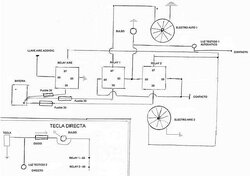
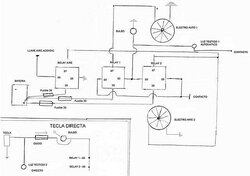
On the internet I have found this diagram in case someone wants to put it into practice.
1B4F573335284F132906334F1328C9.jpg
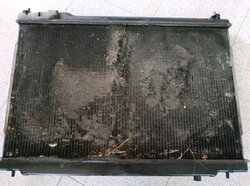
On the other hand, it is very important to have a clean radiator to avoid overheating problems. In our cars it is very complicated without disassembling it, since the both A/C radiator and the coolant radiator are together like a sandwich and the one that is visible on the outside is the A/C. Because the two radiators are so close together, the cooling radiator gets very dirty and that causes overheating. I leave you an image of a FX dirty coolant radiator after 160.000 milles, but that is not seen if it is not disassembled. If it is not cleaned well, it is evident that the cooling power will be greatly reduced.
Radiador_sucio_p.JPG
I recommend before doing any conversion, disassemble the radiator and clean it perfectly to start the conversion to e-fan. This process has to be done very carefully since in the lower part of the radiator there are 2 tubes that are from the transmission fluid circuit and it is very important that when disconnecting the tubes, they are lifted up and covered with a screw so that they are not lose transmission fluid. That is why it is very important to have a clean radiator because it cools the engine and transmission.
With the radiator clean, or it is in bad condition or broken, changing the radiator (from OEM 16mm to aftermarket 26mm thick, with more capacity, for example from Rockauto Radiator DENSO 2213424 or From Ebay Nissens 68118) in hot summer, and a big traffic in the city, with the 2 fans at low speed, the coolant temperature will not exceed 90 degrees (OBD Torque). It would be good to put a temperature gauge that warns if we pass for example 95 or 100 degrees. But if a fuse doesn't blow or something strange happens, it will never go above 90/91 degrees in the most adverse circumstances. E-fan conversion is much more powerful than OEM mechanical fan.
For me, the easiest way to connect it without thermosensor, since the A/C is almost always connected, would be connecting a good 30A fuse and one relay for slow speed fans to a signal KEY ON or ignition key, so that when the car starts it will already turn on slow speed the two fans, and the second Fuse and relay with two fans in high speed mode (It will not be used if everything goes well or the low speed fuse does not blow) with manual switch or it could be connected to the signal cable that Vladimir says of the fan A/C condenser, so high speed fans would be connected only at 95 degrees centigrade.

 

Attachments

  • 1B4F573335284F132906334F1328C9.jpg
    1B4F573335284F132906334F1328C9.jpg
    32.5 KB · Views: 62
Last edited:
Hello, I have done an e-fan conversion for 2005 Infiniti Fx45. I bought this fan which fits perfectly, For 2003-2008 Infiniti FX35 Auxiliary Fan Assembly Dorman 91289VS 2005 2006 2007 | eBay
This fan assembly have 2 ventilator and 2 speeds each. I have it configured that both work at slow speed or at high speed, but both ventilator at the same time.
Vladimir has given very good advice,but the only problem I see is that the fan will turn on at 95 degrees, and that for me is too much. I think it should start at 90/91 degrees Celsius or whenever the A/C is turned on, even if we have not reached 95 degrees.
I also do not recommend using a fan controller, it is not necessary. What I do recommend is a good 70A relay and a good 30A maxi fuse or similar (not Chinese). I have a midi fuse in the battery compartment and it is exposed to a lot of heat so it is better to buy Maxi Fuse/midi Fuse that is made of good quality like the links I put below. The positive cable that goes to the fuse holder can be 6mm2 or 10mm2 (cooper quality).
Portafusibles con tapa para fusibles atornillados tipo MIDI
Fusible MIDI serie 55 de 30A a 125A - Coelectrix
On the internet I have found this diagram in case someone wants to put it into practice.
View attachment 605632
On the other hand, it is very important to have a clean radiator to avoid overheating problems. In our cars it is very complicated without disassembling it, since the both A/C radiator and the coolant radiator are together like a sandwich and the one that is visible on the outside is the A/C. Because the two radiators are so close together, the cooling radiator gets very dirty and that causes overheating. I leave you an image of a FX dirty coolant radiator after 160.000 milles, but that is not seen if it is not disassembled. If it is not cleaned well, it is evident that the cooling power will be greatly reduced.
View attachment 605633
I recommend before doing any conversion, disassemble the radiator and clean it perfectly to start the conversion to e-fan. This process has to be done very carefully since in the lower part of the radiator there are 2 tubes that are from the transmission fluid circuit and it is very important that when disconnecting the tubes, they are lifted up and covered with a screw so that they are not lose transmission fluid. That is why it is very important to have a clean radiator because it cools the engine and transmission.
With the radiator clean, or it is in bad condition or broken, changing the radiator (from OEM 16mm to aftermarket 26mm thick, with more capacity, for example from Rockauto Radiator DENSO 2213424 or From Ebay Nissens 68118) in hot summer, and a big traffic in the city, with the 2 fans at low speed, the coolant temperature will not exceed 90 degrees (OBD Torque). It would be good to put a temperature gauge that warns if we pass for example 95 or 100 degrees. But if a fuse doesn't blow or something strange happens, it will never go above 90/91 degrees in the most adverse circumstances. E-fan conversion is much more powerful than OEM mechanical fan.
For me, the easiest way to connect it without thermosensor, since the A/C is almost always connected, would be connecting a good 30A fuse and one relay for slow speed fans to a signal KEY ON or ignition key, so that when the car starts it will already turn on slow speed the two fans, and the second Fuse and relay with two fans in high speed mode (It will not be used if everything goes well or the low speed fuse does not blow) with manual switch or it could be connected to the signal cable that Vladimir says of the fan A/C condenser, so high speed fans would be connected only at 95 degrees centigrade.
 
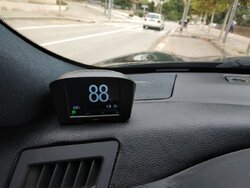
I also recommend to check temperature without installing thermosensor, only read OBD data, like this:
Lector_obd2_temp.JPG
It is connected by cable to the OBD2 port and can help a lot in monitoring the temperature of the engine coolant. Apart from many other parameters, you can set an alarm at for example 93 degrees Celsius to know that everything is perfectly. Normally for me it does not go above 91 degrees, and it goes from 88 to 90 normally with first speed fan , and with the OEM nissan thermostat (new in my case).
https://www.amazon.es/Autool-Multifunción-Digital-temperatura-Vehículos/dp/B01HET7ANE
And for the dashboard issue, here in Catalonia, disassemble, fix without sewing (perfect, one piece as OEM) and assemble, it costs € 600. Like new!
 
Last edited:
Vladimir, thanks for sharing. This sounds much simpler than the install posted ten years ago that involved multiple sensors and controls. Could you clarify a few things for me?
I can install the fan and shroud no problem on my 2004 FX45, and can get 12v power from the battery with inline rising or relays as you mention. However, you lost me a bit on how to connect to the other electric fan in front of the radiator. You mention "getting power from the green wire on the existing electric fan"... do you mean a control signal, rather than power? I thought the power to run the fan was coming from the + and - cable runs to the battery?
Assuming you mean the green wire is some sort of control signal to turn on and off the new fans, and assuming I can find that wire on the existing fan, I sure I can tap it and run it to the new fan unit. But wear does the green wire extension plug into the new fan unit?

You mention a connector with eight leads that you cut off. I assume its four leads duplicated for each fan. Could you describe a bit more which of these are used for 1. The battery run, and 2. The control signal from the green wire splice?

Thanks so much! And sorry for the ignorance - I don't have these parts in hand and I like to make sure I understand the scope of the job before spending any money. If they were in hand, I might could figure it out, but if you're willing to share...
 
Vladimir, thanks for sharing. This sounds much simpler than the install posted ten years ago that involved multiple sensors and controls. Could you clarify a few things for me?
I can install the fan and shroud no problem on my 2004 FX45, and can get 12v power from the battery with inline rising or relays as you mention. However, you lost me a bit on how to connect to the other electric fan in front of the radiator. You mention "getting power from the green wire on the existing electric fan"... do you mean a control signal, rather than power? I thought the power to run the fan was coming from the + and - cable runs to the battery?
Assuming you mean the green wire is some sort of control signal to turn on and off the new fans, and assuming I can find that wire on the existing fan, I sure I can tap it and run it to the new fan unit. But wear does the green wire extension plug into the new fan unit?

You mention a connector with eight leads that you cut off. I assume its four leads duplicated for each fan. Could you describe a bit more which of these are used for 1. The battery run, and 2. The control signal from the green wire splice?

Thanks so much! And sorry for the ignorance - I don't have these parts in hand and I like to make sure I understand the scope of the job before spending any money. If they were in hand, I might could figure it out, but if you're willing to share...


The Green wire, in the case of my 03 FX45, i used as the power wire for the coil on relay that i used to power the fans. In simple - it only ever powers the relay that then swithes on and puts power through, from the battery positive to the fan assy. Keep in mind that different year models might have different wiring colors to the condenser fan - what you want to do is turn the AC on, so the condenser fan strats, and then measure which of the wires bring you the 12V that you're gonna need for the relay.
Then, on the fan assy, each fan motor has two coils, which totals to four wires for each fan motor.
You wanna use an ohm meter to recognise each coil and then power each coil to determine the polarity that will be suitable for pulling the air through the radiator and towards the engine. Each of those four wires, per fan, you can find at the 8pin connector that the fan assy, from an FX35, comes with. The reason why I'm not giving you any colors of wires here is because they could differ from the fan assy manifacturer depending on the year.
To achieve the "high speed", if needed, on any of the two fan motors, you wanna wire the two coils of the motor in paralell, after you have found their correct polarity for pulling air towards the engine.
 
I should mention - this mod, if both fan motors are used at high speed (coils in parallel), will cause a considarable power draw, upwards of 30A on start up and about 20A constant.
So, you have to make sure the cable you run from the battery to the relay, the one that would supply the power for the fan motors, and the ground cable, from the chassis of the car, will be thich enough to support the current without heating up. Your battery and alternator have to be in great shape as well, otherwise, you'll see one of them, or both, fail shortly after that "mod".
And Lastly - doing an electric fan conversion is not done because of power gains, but more so for a more reliable and consistent cooling, and prolonging the life of the water pump.
You will see some improvment it throttle response but that is where the power "gains" end. It is all for more consistent and predictable cooling, less noise and mostly - less rotating mass on the water pump.
 
Thanks. Planning on using 10guage wire, and probably will start only using the low speed on the fans, which won't be close.to 20 amp draw.
When removing the clutch fan - is it obvious when I get the shroud off.how to remove it? I see several bolts around the radius - I'd like to make sure I remove as much as I can, including the heavy clutch assembly. I'm assuming its just bolted in in some way. Would it make sense.to try and replace the existing pulley with an idler type pulley? Or is that one connected to the water pump (per your brief reference in your last post)?
Thanks again! And sorry for all the questions. I'm usually just a dig in and fix it kind of hobbyist, but I'm learning the wisdom of asking those that have "gone before", lol.
 
Thanks. Planning on using 10guage wire, and probably will start only using the low speed on the fans, which won't be close.to 20 amp draw.
When removing the clutch fan - is it obvious when I get the shroud off.how to remove it? I see several bolts around the radius - I'd like to make sure I remove as much as I can, including the heavy clutch assembly. I'm assuming its just bolted in in some way. Would it make sense.to try and replace the existing pulley with an idler type pulley? Or is that one connected to the water pump (per your brief reference in your last post)?
Thanks again! And sorry for all the questions. I'm usually just a dig in and fix it kind of hobbyist, but I'm learning the wisdom of asking those that have "gone before", lol.


I think 10 gauge sould hold up just fine.
As far as the clutch/fan Assy it comes out as one unit.
Remove only the four bolts holding it to the water pump, then detach the shroud from the radiator and pull everything (shroud+fan/clutch assy) up and out. This is your easiest way! I cannot quite remember if the upper radiator hose had to come out as well...
After all of that mess is out, put those four bolts that used to hold the fan/clutch assy back - they are needed to hold the water pump pulley on tight.
Then proceed to the FX35's electric fan assy install - they fit exactly because the radiator has the mounting points already, however, there is interference with the bottom radiator hose and one of the fans (driver side) so you have to either trim or remove one of those leg/bracket holding the fan motor to the fan assy.
You'll see what I'm talking about once you try to lower the electric fan assy in place - whatever you do, make sure the lower radiator hose does not rub on the fan assy.
 
There isn't that much wiring involved.
You'll need a positive cable from the battery - don't forget an inline fuse, 40A should suffice.
You'll also need a negative from the chassis of the car.
And finally a relay, cause you gonna run two fan motors now, you don't wanna overload the power wire to that existing condenser fan.
The power wire you want from that fan is green in color. You can either cut it, thus eliminating the original condenser fan, or splice into it - this way it would run together with the new fan assembly you're installing.
On the fan assembly there will be a big 8pin connector - i cut that one off, before installing the fans in the car, and powered each individual fan motor to determine low and high speed modes.
In my case, i only used the low speed on both fans running together and that is sufficient to cool the coolant from 95°C to 87°C in 35 seconds or less when the air temperature outside is 100°F - those 2 electric fans are much more efficient than the original mechanical one.
All in all, this conversion is easy and does NOT require drilling thermostat housings or adding fan controllers.

I wish I saw this before purchasing a Dakota Digital controller PAC-2800BT along with the BIM OBDII expansion pack to avoid using an external temp sensor . I wanted to keep it looking clean and oem like to avoid melting wires so I decided to go with a 10/4 awg wires to keep the setup looking clean! I’m also thinking of getting a 40A in-line circuit breaker for the battery line between the controller and the battery itself. I’ve had a case back in the day where a power wire from the battery to the music amp in my old 95 Acura Integra melted and took the throttle cable along with it, so I was only able to move in drive with absolutely no ability to accelerate so I’m not taking my chances
 
Back
Top