Audi R8 led headlights for all

there are so many threads in so many forums of leds in headlights not lasting... even the big guys in the custom headlight gig are having problems with led longevity... audi must use heat sinks & some engineering to allow there leds to last, leds don't like high temps & the problem is that the insides of headlights with HID's & engine heat get very hot... can't wait to get my hands on one of these smashed up so I can see the guts of the audi headlights & see what there doing to have there leds last long term...
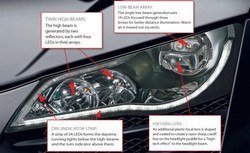
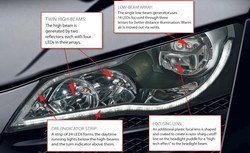
This is from Car and Driver in regard to the R8 headlight assemblies: (Note the use of heat shields in the photo and dual purpose cooling/defrosting fans in the description.)

Are incandescent headlights on their last flicker? They lit the road ahead for almost a century, but interest in incandescence, or light made with heat by pushing current through a thin filament, is going cold.
Light-emitting diodes, or LEDs, promise greater light for less power and waste heat. Already used in taillights and turn signals, the LEDs’ steadily improving efficiency means this technology is moving up to the big job. They’ll be the standard-equipment headlights on the 2010 Audi R8 V-10 and optional on the V-8 R8. U.S. prices aren’t finalized, but *Europeans will pay about $5000 for the set.
Why is Audi pursuing this technology? Simple: LEDs make more light than heat and take up less space. There is another benefit, too: LEDs can be arranged into whatever shapes designers and engineers demand—especially important to a style-leading brand such as Audi.
The common incandescent halogen bulb shines by electrifying and superheating a tungsten filament sealed in halogen gas. Less than five percent of the power consumed results in light, the rest is heat that is wasted. The ratio is somewhat better with high-intensity-discharge, or HID, headlights, where instead of passing over a solid filament, the current arcs between two filaments through a cloud of light-amplifying xenon gas.
__________________________________________________________________________________
2010-audi-r8-led-headlight-tech-dept-labeled-1280_cd_gallery.jpg
_________________________________________________________________________________
Instead of incandescent, an LED is electroluminescent. Light is produced by electrifying a material, in this case a silicon chip, which is treated to be a diode, or a conductor through which electrons flow only one way. Varying the voltage to both sides of the diode excites the electrons, and their movement creates photons, or light.
Thanks to chip improvements, LED output is whiter and also brighter, from 15 lumens per watt in 2001, when Audi started its research, to 60 today, says Audi’s light engineering director, Stephan Berlitz. In the R8, the LEDs are clustered—14 for the low beam, eight for the high beam—and cooled by fans to keep internal temps below a diode-killing 300 degrees F. The fans also circulate warm air to defrost the lenses on cold mornings.
Berlitz says costs will remain high until more automakers adopt LED technology. Until then, LED hype will generate more heat than light.
 

Attachments

  • 2010-audi-r8-led-headlight-tech-dept-labeled-1280_cd_gallery.jpg
    2010-audi-r8-led-headlight-tech-dept-labeled-1280_cd_gallery.jpg
    59.2 KB · Views: 6
yeah, maybe I can liquid cool the leds in the headlights then.... NOT :rolleyes: been there done that though on a sunlight viewable lcd with led backlight that I built years ago though... winded up bright enough to overpower the sun itself :tonguey: all aluminum/copper construction... would be crazy to do this for headlights though...

17401d1122422142-800x1280-narrowscreen-cimg2010.jpg


18369d1123985007-800x1280-narrowscreen-cimg2025.jpg


20370d1129002444-800x1280-narrowscreen-cimg2179.jpg
 
Back
Top