
You are using an out of date browser. It may not display this or other websites correctly.
You should upgrade or use an alternative browser.
You should upgrade or use an alternative browser.
Exhaust port question
- Thread starter Logan
- Start date
- Location
- South Gate, CA
- Car
- 2003 FX45 AWD
never heard of this question before..

- Location
- Dallas, TX
- Car
- 2007 FX35 RWD
- Location
- brooklyn, ny
don't get too caught up with thinking you have to exactly match the actual port size. as a reference I think nismo titan headers are 1 5/8" primaries... the choices would be anywhere from
1-1/2"
1-5/8"
1-3/4"
1-7/8"
a lot of what you choose will determine the overall tune of the headers, as well as what your planning as far as shorties, tri Y's or straight up long tube... the collector(s) design also come into play a lot in the overall design....
my opinion if you were doing turbo would be to stay with the 1-1/2" primary max to keep velocities high & overall manifold volume down, but as a cammed NA your probably going to want to lean more towards the 1-5/8" over 1-1/2" primaries... can't see much reason to consider going larger than 1-5/8" at all unless you were really planning some sort of supercharged monster build... then 1-3/4" or maybe even 1-7/8" for a real monster 700hp+ build...
the merge collector can play as much of a role as the primary size, but I couldn't really tell you exactly what would be "best", the truth is there really is no "best", changes here will change the torque curve & overall power response across the board... now comes the question of what are your design goals?
a header deigned to make the most amount of HP will sacrifice some low end torque & vice versa... on a street car like this I think I'd concentrate on low end torque which would also push you more towards the 1-1/2" primary size. I think i'd talk to the cam manufacturer & ask what he recommends but I'm going to bet everything's going to be centered right around the 1-5/8" primaries over a more conservative 1-1/2" which would probably be the only other practical sized primaries to consider, another good company to consult with is burns stainless as they can not only supply the materials to build the headers, but can also design & build a custom collector too...
just shooting from the cuff I'd say either 1-1/2"-1-5/8" primaries in a long tube design with maybe a 2-1/2"-2-5/8" collector(maybe necked down from a 2-1/4"-2-1/2" choke for best scavenging if your looking to go all out)... again burns would be great to consult with about the collectors... you can check out there x-design software that helps design stuff like this here: http://www.burnsstainless.com/x-design.aspx
---------- Post added at 10:00 PM ---------- Previous post was at 09:53 PM ----------
actually the more I think about it, with a fairly restrictive full exhaust I don't think you'd even see any benefit from a choke at the collector so that probably doesn't apply...
1-1/2"
1-5/8"
1-3/4"
1-7/8"
a lot of what you choose will determine the overall tune of the headers, as well as what your planning as far as shorties, tri Y's or straight up long tube... the collector(s) design also come into play a lot in the overall design....
my opinion if you were doing turbo would be to stay with the 1-1/2" primary max to keep velocities high & overall manifold volume down, but as a cammed NA your probably going to want to lean more towards the 1-5/8" over 1-1/2" primaries... can't see much reason to consider going larger than 1-5/8" at all unless you were really planning some sort of supercharged monster build... then 1-3/4" or maybe even 1-7/8" for a real monster 700hp+ build...
the merge collector can play as much of a role as the primary size, but I couldn't really tell you exactly what would be "best", the truth is there really is no "best", changes here will change the torque curve & overall power response across the board... now comes the question of what are your design goals?
a header deigned to make the most amount of HP will sacrifice some low end torque & vice versa... on a street car like this I think I'd concentrate on low end torque which would also push you more towards the 1-1/2" primary size. I think i'd talk to the cam manufacturer & ask what he recommends but I'm going to bet everything's going to be centered right around the 1-5/8" primaries over a more conservative 1-1/2" which would probably be the only other practical sized primaries to consider, another good company to consult with is burns stainless as they can not only supply the materials to build the headers, but can also design & build a custom collector too...
just shooting from the cuff I'd say either 1-1/2"-1-5/8" primaries in a long tube design with maybe a 2-1/2"-2-5/8" collector(maybe necked down from a 2-1/4"-2-1/2" choke for best scavenging if your looking to go all out)... again burns would be great to consult with about the collectors... you can check out there x-design software that helps design stuff like this here: http://www.burnsstainless.com/x-design.aspx
---------- Post added at 10:00 PM ---------- Previous post was at 09:53 PM ----------
actually the more I think about it, with a fairly restrictive full exhaust I don't think you'd even see any benefit from a choke at the collector so that probably doesn't apply...
Last edited:
Util now I had not given it any thought.never heard of this question before..
Are they even perfectly circular? They have always been oval or rounded off rectangles on my rides.
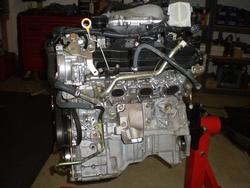
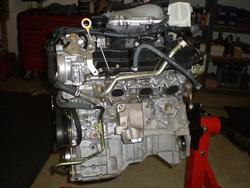
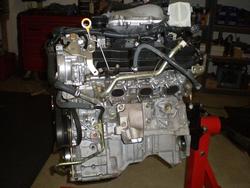
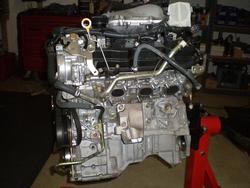
As you can see, the VQ has some weird mix of an oval and rectangle thing.
don't get too caught up with thinking you have to exactly match the actual port size. as a reference I think nismo titan headers are 1 5/8" primaries... the choices would be anywhere from
1-1/2"
1-5/8"
1-3/4"
1-7/8"
a lot of what you choose will determine the overall tune of the headers, as well as what your planning as far as shorties, tri Y's or straight up long tube... the collector(s) design also come into play a lot in the overall design....
my opinion if you were doing turbo would be to stay with the 1-1/2" primary max to keep velocities high & overall manifold volume down, but as a cammed NA your probably going to want to lean more towards the 1-5/8" over 1-1/2" primaries... can't see much reason to consider going larger than 1-5/8" at all unless you were really planning some sort of supercharged monster build... then 1-3/4" or maybe even 1-7/8" for a real monster 700hp+ build...
the merge collector can play as much of a role as the primary size, but I couldn't really tell you exactly what would be "best", the truth is there really is no "best", changes here will change the torque curve & overall power response across the board... now comes the question of what are your design goals?
a header deigned to make the most amount of HP will sacrifice some low end torque & vice versa... on a street car like this I think I'd concentrate on low end torque which would also push you more towards the 1-1/2" primary size. I think i'd talk to the cam manufacturer & ask what he recommends but I'm going to bet everything's going to be centered right around the 1-5/8" primaries over a more conservative 1-1/2" which would probably be the only other practical sized primaries to consider, another good company to consult with is burns stainless as they can not only supply the materials to build the headers, but can also design & build a custom collector too...
just shooting from the cuff I'd say either 1-1/2"-1-5/8" primaries in a long tube design with maybe a 2-1/2"-2-5/8" collector(maybe necked down from a 2-1/4"-2-1/2" choke for best scavenging if your looking to go all out)... again burns would be great to consult with about the collectors... you can check out there x-design software that helps design stuff like this here: http://www.burnsstainless.com/x-design.aspx
Excellent input regarding size and the choice of what will flow best rather than what fits the port best. My builder is also suggesting Burns collectors (man you have really been digging deep into this stuff John)
His last comment on the layout: As for performance. "For the best powerband I would go with the 4-2-1 setup. 4-1 headers will make good power, are cheaper to produce, is faster to build (generally) but does not always extract as much power on a milder engine setup like a street engine. On the setup for the VK45 DE with the cams you purchased, the best option is the most expensive one with the burns collectors. The 4-2-1 headers do take longer to build timewise by about 20% as there is more material to fabricate but I am not charging you the difference here for that."
Do you agree with the 4-2-1? I'd like to maintain as much low end as possible. the CAM's are supposed to be fairly broad spectrum and the TB is supposed to add back in more low to mid, combined with the headers I am hoping for a little more gain in low end response.
Really wish I had idea of what this is going to sound like when it is completed.
Attachments
- Location
- brooklyn, ny
421 is a tri Y, there called this cause there are 3 Y's. 2 ports merge, the other 2 merge, that's 2 Y's, then these two also merge for the third Y...
this design can be more compact & might be easier to fit & build depending on a lot of things, like firing orders, port layout & available space... the material difference is pretty trivial compared to the labor involved. that's the bulk of the expense here. I think overall tri y's might be easier, but I also think that proper tri y's can be very difficult to design & build...
from what I know equal length long tube headers are going to be best for torque no question and also be less hit or miss, I'd say that's the way to go if you really want the best & they can pull it off, but packaging constraints might make that impractical or much more costly... a properly designed tri y can be great too, but they really need to be designed right, with opposing cylinders paired & lengths matched so they scavenge at each of the y's... then you've got primary size and secondary size & final outlet size to consider which all affect performance, theres a lot more room for error in a tri y design...
a good tri Y can be very efficient at scavenging & boost low end torque, but keep in mind that a bad tri Y is a whole lot easier to build than a good one... this is the kind of thing that you don't really know if it's good or bad till it's on the dyno, until then it's just theory. the theory & science behind a proper tri Y is more complicated than a long tube equal length header... what this means is it's more of a gamble actual performance wise going tri y than it is going long tube equal length... tri y can be more hit or miss where long tubes are easier to get "right"... especially considering your not going to have the luxury of building multiple designs & comparing them to each other on a dyno, without that kind of R&D the safer bet is going to be the long tube equal lengths for that reason alone. doesn't mean tri y's are bad, just that the bulls eye is very tiny compared to the long tube & chances are much higher of the end design being much less close to optimal...
---------- Post added at 01:14 AM ---------- Previous post was at 12:55 AM ----------
I also noticed now that you talk about him mentioning 4-1 but I don't think he's talking long tube, more like 4-1 shorties... 4-1 shorty headers are probably the cheapest option but yeah, I guess I'd probably want to lean towards tri y over just 4-1 shorties.... the 4-1 I'm talking about is long tube equal length.... I'm not even sure if that's even something being considered here... if not then yeah I'd probably agree more towards the tri y but I'd def at least mention/ask about the possibility of long tube headers.... of course this means new cats & reworking the Y pipe too.... were you planning on trying to just make something just bolt in to the original cats?
this design can be more compact & might be easier to fit & build depending on a lot of things, like firing orders, port layout & available space... the material difference is pretty trivial compared to the labor involved. that's the bulk of the expense here. I think overall tri y's might be easier, but I also think that proper tri y's can be very difficult to design & build...
from what I know equal length long tube headers are going to be best for torque no question and also be less hit or miss, I'd say that's the way to go if you really want the best & they can pull it off, but packaging constraints might make that impractical or much more costly... a properly designed tri y can be great too, but they really need to be designed right, with opposing cylinders paired & lengths matched so they scavenge at each of the y's... then you've got primary size and secondary size & final outlet size to consider which all affect performance, theres a lot more room for error in a tri y design...
a good tri Y can be very efficient at scavenging & boost low end torque, but keep in mind that a bad tri Y is a whole lot easier to build than a good one... this is the kind of thing that you don't really know if it's good or bad till it's on the dyno, until then it's just theory. the theory & science behind a proper tri Y is more complicated than a long tube equal length header... what this means is it's more of a gamble actual performance wise going tri y than it is going long tube equal length... tri y can be more hit or miss where long tubes are easier to get "right"... especially considering your not going to have the luxury of building multiple designs & comparing them to each other on a dyno, without that kind of R&D the safer bet is going to be the long tube equal lengths for that reason alone. doesn't mean tri y's are bad, just that the bulls eye is very tiny compared to the long tube & chances are much higher of the end design being much less close to optimal...
---------- Post added at 01:14 AM ---------- Previous post was at 12:55 AM ----------
I also noticed now that you talk about him mentioning 4-1 but I don't think he's talking long tube, more like 4-1 shorties... 4-1 shorty headers are probably the cheapest option but yeah, I guess I'd probably want to lean towards tri y over just 4-1 shorties.... the 4-1 I'm talking about is long tube equal length.... I'm not even sure if that's even something being considered here... if not then yeah I'd probably agree more towards the tri y but I'd def at least mention/ask about the possibility of long tube headers.... of course this means new cats & reworking the Y pipe too.... were you planning on trying to just make something just bolt in to the original cats?
Last edited:

421 is a tri Y, there called this cause there are 3 Y's. 2 ports merge, the other 2 merge, that's 2 Y's, then these two also merge for the third Y...
this design can be more compact & might be easier to fit & build depending on a lot of things, like firing orders, port layout & available space... the material difference is pretty trivial compared to the labor involved. that's the bulk of the expense here. I think overall tri y's might be easier, but I also think that proper tri y's can be very difficult to design & build...
from what I know equal length long tube headers are going to be best for torque no question and also be less hit or miss, I'd say that's the way to go if you really want the best & they can pull it off, but packaging constraints might make that impractical or much more costly... a properly designed tri y can be great too, but they really need to be designed right, with opposing cylinders paired & lengths matched so they scavenge at each of the y's... then you've got primary size and secondary size & final outlet size to consider which all affect performance, theres a lot more room for error in a tri y design...
a good tri Y can be very efficient at scavenging & boost low end torque, but keep in mind that a bad tri Y is a whole lot easier to build than a good one... this is the kind of thing that you don't really know if it's good or bad till it's on the dyno, until then it's just theory. the theory & science behind a proper tri Y is more complicated than a long tube equal length header... what this means is it's more of a gamble actual performance wise going tri y than it is going long tube equal length... tri y can be more hit or miss where long tubes are easier to get "right"... especially considering your not going to have the luxury of building multiple designs & comparing them to each other on a dyno, without that kind of R&D the safer bet is going to be the long tube equal lengths for that reason alone. doesn't mean tri y's are bad, just that the bulls eye is very tiny compared to the long tube & chances are much higher of the end design being much less close to optimal...
---------- Post added at 01:14 AM ---------- Previous post was at 12:55 AM ----------
I also noticed now that you talk about him mentioning 4-1 but I don't think he's talking long tube, more like 4-1 shorties... 4-1 shorty headers are probably the cheapest option but yeah, I guess I'd probably want to lean towards tri y over just 4-1 shorties.... the 4-1 I'm talking about is long tube equal length.... I'm not even sure if that's even something being considered here... if not then yeah I'd probably agree more towards the tri y but I'd def at least mention/ask about the possibility of long tube headers.... of course this means new cats & reworking the Y pipe too.... were you planning on trying to just make something just bolt in to the original cats?
My bet guess is that he can make a solid tri-Y, gotta say though I'd really be disheartened to get less what I am hoping for on the Dyno. The shorties are a few hundred cheaper but I am thinking if I am going to do it, do it right....Hey, kinda like TC6 motor sports

He offered me five options and five price points, he is suggesting either:
4) 4-2-1 design with good generic merge collectors. This type will be
a good Tri-Y setup so there will be 3 collectors per bank. Proper
cylinder pairing, and probably the best setup and design for this
engine with these modifications. Slip fit tubes again like the above
setups.
5) 4-2-1 design like above, but with top of the line burns stainless
collectors.
Regarding the Cat hook up he also has a way of deleting the cats that tricks the sensors into thinking its all good. He swears No CEL's and that it will pass emissions.
I'll get more info before I proceed and ping you with all the dirty details.
Share: